

The most revealing thing about Chhote Lal Yadav‘s coaching career is that his name rarely appeared before those of his boxers. Mary Kom took the headlines. Jaismine Lamboria took the podium. Sakshi Chaudhary and Arundhati Choudhary collected medals. Yadav remained where he has spent much of his career, a few steps away from the spotlight, studying, adjusting and preparing his athletes for the next fight.
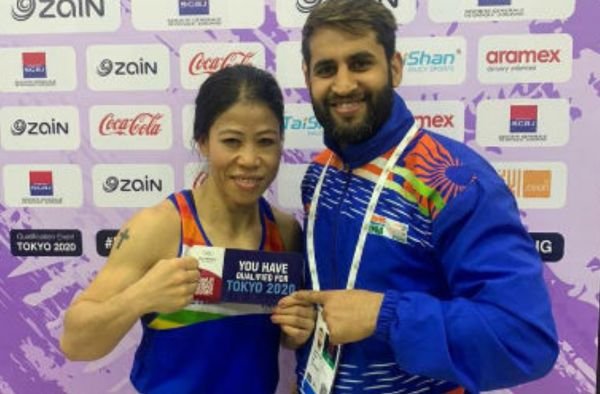
That quiet work has now received one of Indian sport’s highest recognitions. Yadav was named among the recipients of the 2025 Dronacharya Award in the regular category for boxing, alongside athletics coach Parveer Singh and shooting coach Neha Chavan. The award recognises coaches whose sustained work has helped athletes excel at major international competitions.
For a 38-year-old Army man whose career has moved from boxer to coach, the honour represents more than recognition for a list of medals. It acknowledges a philosophy built around adaptation. “I am very happy but I don’t have to stop here. I need to work harder. My aim is that my boxers win 2-3 gold medals at the LA Olympics,” Yadav said. That ambition is consistent with the way his coaching career has developed. He has not attempted to impose a single formula on every athlete.
Instead, his defining quality has been his ability to understand what a particular boxer needs at a particular point in their career. Yadav’s own boxing career provided the foundation. He entered the Army’s Boys Sports Company in Pune after moving from Varanasi in 2000 and joined the Army in 2005. He became part of India’s national setup, progressing through the sub-junior, junior and senior levels and competing internationally.
His most productive period as a boxer came in the featherweight category, where he became national champion for three consecutive years from 2008 to 2010. His career also included an Asian Championships gold. The Olympic dream, however, was interrupted by injury. A back and spinal injury in 2012 forced him out of competitive boxing. For many athletes, that would have been the end of the journey. For Yadav, it became a turning point. He moved towards coaching and, in the same year, was asked to work with Mary Kom for a short period. The assignment was initially expected to last only a few weeks.
Instead, it became the beginning of one of the most important relationships of his career. Yadav completed his coaching diploma at the National Institute of Sports, Patiala, in 2014 and by 2017 had begun working with Mary Kom full-time. The Boxing Federation of India had already recognised his coaching credentials. Its records show Yadav working with India’s elite women’s boxing setup in 2017, including at national camps and international competitions.
Mary Kom did not need to be introduced to championship boxing when Yadav entered her corner. She was already one of the greatest boxers India had produced, with multiple world titles and an Olympic medal. The challenge was different: how do you keep an established champion performing at the highest level as age, workload and physical demands change?
“She was a champion before I started training her. My biggest challenge was how to keep a celebrity and champion a champion,” he recalled. His response was to move away from conventional training assumptions and develop what he called “smart training”. “It was a challenge for me at that time, I was not sure if it would work, but it did.” The results were immediate and significant. Mary Kom won the Asian Championships in 2017, followed by Commonwealth Games gold and another World Championships title. She also qualified for the Tokyo Olympics.
For Yadav, the Asian Championships triumph carried particular significance. “Since the 2014 Asian Games gold Mary hadn’t won anything in a big tournament and hadn’t qualified for the Olympics also. So to win that made me very happy.” The lesson was clear. Coaching an experienced champion is not necessarily about making the athlete train harder. Sometimes it is about making the athlete train smarter. “I make a personalised training programme for every boxer,” he said. That philosophy would later become central to his work with a new generation.
Yadav remained part of the national camp until 2022, when he moved away from the setup and took charge of the Army’s women’s boxing programme. The transition brought a different challenge. There was no established superstar this time. There was a group of young boxers who needed to be developed.
Jaismine Lamboria was among the first athletes he worked with, followed by Sakshi Chaudhary and Arundhati Choudhary. The results have transformed the programme’s profile. Jaismine won the women’s 57kg gold at the 2025 World Boxing Championships, a breakthrough that confirmed her arrival at the top level. The achievement was formally recognised by the Prime Minister, who described her victory as an inspiration for future athletes.
She then added another major achievement by winning gold in the women’s 57kg category at the 2026 Commonwealth Games in Glasgow. Behind those victories was a coach who had already seen what happens when an athlete loses confidence. “He has a huge role in my World Championship title. He worked on my technical and strength training after the Paris Olympics. He changed my game with strength,” Jaismine said.
After Jaismine missed the Paris Olympics, Yadav changed her programme, increasing the emphasis on strength training and body-weight exercises. “After the Paris Olympics she was completely down. Then I changed her programme and everything. For that to work and for her to become a world champion meant a lot to me,” he said. That is perhaps the clearest explanation of Yadav’s coaching philosophy. Mary Kom needed a programme designed to prolong the career of an established champion. Jaismine needed one that could rebuild confidence and transform her physical game.
The coach behind the medals Jaismine’s assessment of Yadav captures another important part of his approach. “Chhote sir knows everything about women’s boxing — how to train, how to recover. He is very open-minded, so we are able to share things with him comfortably,” she said. The willingness to listen can be as important as technical knowledge in elite sport.
A coach working with women athletes, particularly at the highest level, has to understand recovery, workload, communication and individual needs alongside boxing technique. “He makes personalised programmes for everyone. If he doesn’t know something, he doesn’t assert control. He will take you to the expert in that subject. And he always takes a stand for us.”
That may explain why Yadav’s influence has extended beyond a single athlete. His career has moved through national camps, the Army system and elite women’s boxing, allowing him to work with athletes at different stages of development. His own sporting background has also given him an understanding of what athletes experience before they reach the podium.
The Dronacharya Award does not appear to have changed his priorities. The Ministry of Youth Affairs and Sports describes the honour as recognition for coaches who consistently do outstanding and meritorious work and enable athletes to excel at international events. Yadav’s record now fits that description across generations. There is the resurgence of Mary Kom, the rise of Jaismine and the emergence of other Army boxers who have begun winning major medals. But the award has not turned his attention backwards.
“To tell you the truth, I don’t know anything apart from boxing and coaching in life. I always want to be a good coach,” he said. That sentence perhaps explains why his career has been so quietly effective. A boxer measures success in punches landed, rounds won and medals collected. A coach measures it differently. The evidence appears years later, when an athlete who once struggled begins winning, when a champion finds another level late in a career, or when a young boxer discovers the confidence to believe that the biggest stage belongs to her too.

