

The final medal table may read 21 gold, 27 silver and 37 bronze for India, but the story of the Aichi-Nagoya Asian Games is far richer than the numbers suggest. And within India’s 85-medal campaign, the performances of its women athletes stood out as one of the defining narratives of the Games. India finished fourth overall, matching its position from Hangzhou 2022, despite winning fewer medals than three years ago. After a relatively slow beginning, the Indian contingent produced a dramatic late surge, collecting 17 gold medals in the final five days of competition.
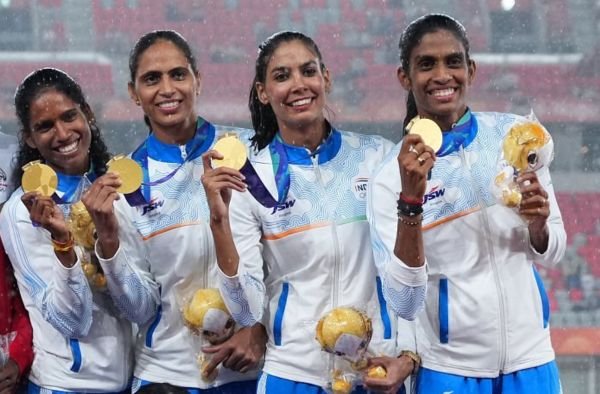
For Indian women, that late charge produced historic breakthroughs across archery, shooting, athletics, golf, boxing, hockey and squash. At the centre of it all was 17-year-old archer Kumkum Mohod, who transformed her Asian Games debut into a campaign that will be remembered for years.
Kumkum Mohod: The teenager who broke Korea’s wall
Kumkum finished the Games with two gold medals and one silver, becoming one of India’s most successful individual performers in Aichi-Nagoya. Her biggest achievement came in the women’s individual recurve event, where she became the first Indian woman to win an individual recurve gold at the Asian Games. Her route to the title was anything but routine. She defeated Korea’s top seed and reigning world champion Kang Chaeyoung before overcoming China’s world No. 3 Zhu Jingyi.
The teenager had already helped India create history in the women’s recurve team event alongside Ankita Bhakat and Kirti. India defeated South Korea 5-3, ending Korea’s remarkable run of seven consecutive Asian Games team titles dating back to 1998. Kumkum’s third medal came in the mixed team event, where she and Dhiraj Bommadevara won silver. Her individual gold also secured a quota place for India at the Los Angeles 2028 Olympic Games, adding another layer to an extraordinary debut.
Neeru Dhanda makes shooting history
If Kumkum was the breakout teenager, Neeru Dhanda was the shooting team’s headline performer. The trap shooter won India’s first-ever women’s individual trap gold at the Asian Games, producing a record score of 28 in the final. The International Shooting Sport Federation confirmed that her winning performance was an Asian Games record.
Dhanda’s gold came after she had already contributed to India’s silver in the women’s trap team event with Manisha Keer and Aashima Ahlawat. She then added another gold in the mixed trap team event with Kynan Chenai, finishing the Games with two golds and one silver. In a shooting campaign that did not produce India’s biggest overall medal haul, Dhanda became the standout performer and one of the clearest examples of an athlete turning pressure into history.
Vithya Ramraj runs into the record books
Athletics produced another major women’s storyline through Vithya Ramraj, whose three-medal campaign included gold, silver and bronze. Her biggest medal came in the women’s 4x400m relay, where India won gold in 3:29.69. Vithya’s late surge helped India pull away from China in one of the memorable finishes of the Games. She also contributed to India’s silver in the mixed 4x400m relay. But it was her individual 400m hurdles performance that added another layer to her campaign.
Vithya clocked 54.75 seconds, becoming the first Indian woman to break the 55-second barrier in the event and lowering the long-standing national record associated with PT Usha. World Athletics lists 54.75 as her new personal best, achieved in Nagoya on September 28, 2026. Her three medals made her one of the most successful Indian athletes of the Games.
Pranavi Urs adds a historic golf gold
India’s women’s golf campaign also delivered a landmark moment through Pranavi Urs. Urs won the women’s individual gold, becoming the first Indian woman to claim an individual Asian Games golf title. She also helped India secure silver in the women’s team event. Her performance was part of a wider trend at these Games: Indian women were not merely adding medals, they were breaking barriers in events where the country had previously struggled to reach the top step.
Anahat Singh won silver in women’s singles squash and bronze in the women’s team event, becoming the first Indian woman to win an Asian Games women’s singles silver in squash. Parul Chaudhary collected two bronze medals in athletics, while Harita Bhadra also finished with two bronze medals. In shooting, Elavenil Valarivan secured two silver medals, while Esha Singh fought through a tense women’s 25m pistol final to win silver after surviving multiple shoot-offs.
In boxing, India’s women also made a major statement. Lovlina Borgohain and Parveen Hooda won gold medals, while India’s women’s boxing programme finished as the leading force in the competition. And in hockey, India’s women returned to the top of the Asian Games podium after a 44-year wait, defeating China 1-0 in the final.
The most important takeaway from India’s Aichi-Nagoya campaign may not be the final tally of 85 medals. It is the breadth of women’s success across disciplines. Kumkum Mohod represented the next generation, arriving at her first Asian Games as a teenager and leaving as a double gold medallist and an Olympic quota holder. Neeru Dhanda demonstrated what sustained precision under pressure can produce, becoming the first Indian woman to win Asian Games trap gold.
Vithya Ramraj turned a relay gold into an individual record-breaking campaign. Pranavi Urs created a new chapter in Indian golf. Anahat Singh showed that Indian squash continues to have a powerful women’s pipeline. Elavenil Valarivan and Esha Singh strengthened India’s presence in shooting, while Lovlina Borgohain and Parveen Hooda underlined the growing depth of Indian women’s boxing. These performances suggest something bigger than a successful fortnight.
Indian women’s sport is increasingly producing athletes capable of entering competitions not merely hoping for a medal, but expecting to challenge for gold. Aichi-Nagoya 2026 may ultimately be remembered as the Games where that confidence became impossible to ignore.
