

From Olympic disciplines to virtual taekwondo, surfing and teqball, the Aichi-Nagoya Asian Games promise a blend of established rivalries and new-age sport as India begins another continental medal campaign. The wait is over. The 20th Asian Games are set to open in Aichi-Nagoya, Japan, on September 19, bringing together athletes from across the continent for 16 days of competition, ambition and medal battles. The Games will run until October 4 and feature 43 sports, 71 disciplines and 469 medal events, with more than 11,000 athletes and around 6,000 officials from 45 countries and regions expected to be part of the event.
For India, the Games carry a particularly significant target. The country returns after its record-breaking campaign at the Hangzhou Asian Games, where it won 107 medals, including 28 gold, 38 silver and 41 bronze, its best-ever tally at the continental Games. The Indian contingent in Aichi-Nagoya will look to build on that momentum. But this edition is not simply about defending old records. The sporting programme itself has changed, with several disciplines making their Asian Games debut and bringing unfamiliar formats to the continental stage.
A new-look Asian Games:
While the Asian Games remain anchored by athletics, swimming, boxing, wrestling, badminton, shooting and other established Olympic sports, Aichi-Nagoya will also introduce a new generation of competition. Mixed martial arts, padel, surfing, teqball, BMX freestyle and virtual taekwondo are among the disciplines making their Asian Games debut. The official Games programme also includes esports.
Virtual taekwondo could prove to be one of the most unusual spectacles. Rather than athletes physically striking one another, competitors use virtual reality equipment and motion-tracking technology to translate their movements into a digital arena. The format is designed around speed, precision and reaction, offering a contact-free version of the traditional combat sport.
Padel, meanwhile, brings a rapidly expanding racket sport to the continental Games. Played on a smaller court surrounded by glass walls, the sport combines elements of tennis and squash and places a premium on quick reactions and doubles coordination.
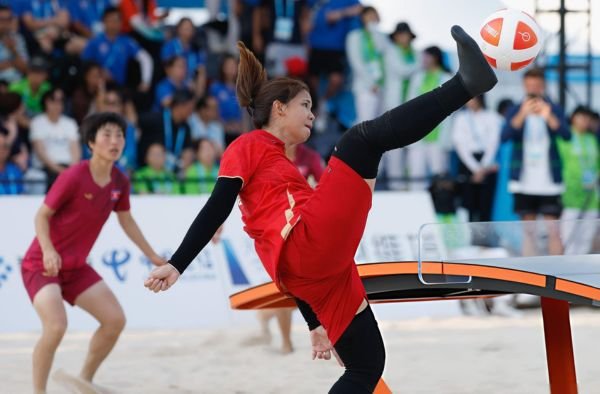
Teqball takes football skills and puts them around a curved table. Players use their feet, knees, chest and head to return the ball while attempting to outmanoeuvre their opponents.
Surfing also makes its Asian Games debut after appearing at the Olympic Games in Tokyo. Athletes will be judged on factors including the difficulty and execution of their manoeuvres, while the changing conditions of the sea remain an unpredictable part of the competition.
BMX freestyle offers another visual spectacle, with riders judged on tricks, height, difficulty, originality and execution rather than simply racing to the finish line.
India enters with a record to protect. The Indian contingent arrives in Japan carrying the weight of its Hangzhou success. At the 2022 Asian Games, held in Hangzhou in 2023, India crossed the 100-medal mark for the first time at the Asian Games. That performance included historic achievements in athletics, shooting, archery, hockey, cricket and several other disciplines.
A similar medal haul would represent another landmark, but the competitive landscape remains demanding. China, Japan, South Korea, Uzbekistan, Kazakhstan and other major sporting nations will provide stiff competition across the programme. India’s challenge will therefore extend beyond repeating individual successes. Athletes will need to convert world-level and Olympic experience into medals against opponents who have also been preparing specifically for the continental Games.
When will the Asian Games begin?
Although the official opening ceremony takes place on September 19, several competitions began before the ceremony, including basketball and football. The official Games calendar runs from September 19 to October 4. The opening ceremony will be held at the Nagoya City Mizuho Park Athletic Stadium, beginning at 6 pm local time. The same venue will also host athletics during the Games. The organisers have planned competition across 54 venues, spreading the Games beyond Nagoya and throughout Aichi Prefecture. The Toyota Stadium, for example, will host football, including the men’s final, while the newly opened Aichi International Arena is being used for basketball and later for judo.
The Aichi-Nagoya Games arrive as more than a sporting competition. Organisers have framed the event around the idea of bringing Asia together, with the official motto “Imagine One Asia”. The Games will also give newer sports an opportunity to reach a wider audience and test their place within the continental sporting ecosystem. For India, however, the equation remains straightforward once competition begins. Every qualification, every final and every medal opportunity will contribute to the country’s overall campaign. The target is clear, but the route is anything but simple.
Aichi-Nagoya 2026 is arriving at an interesting point in Asian sport. The Games retain the traditional strength of athletics, shooting, wrestling, boxing, badminton and swimming, while simultaneously opening the door to sports shaped by technology, changing sporting habits and younger audiences. For India, the story is equally about continuity and expansion. Hangzhou established a new benchmark with a record medal haul. Aichi-Nagoya will now show whether that performance was the beginning of a sustained rise across multiple disciplines.
The first medals will answer only one part of the question. Over the next 16 days, India’s campaign will also reveal which sports can consistently deliver at the continental level, which emerging athletes can step onto the big stage and how far the country’s sporting depth has developed since Hangzhou.
