

Some sporting moments are measured by medals. Others are remembered because they quietly redefine what is possible.
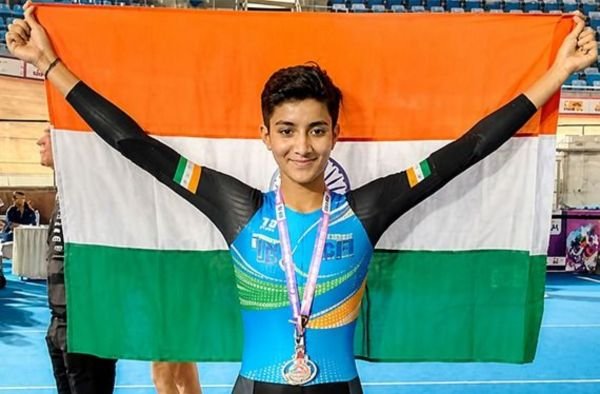
Harshita Jakhar did not stand on the podium at the Tour de France Femmes. She did not win a stage or wear the coveted yellow jersey. Yet, when the 19-year-old from Rajasthan rolled onto the start line during Stage 2 of the world’s biggest women’s cycling race, she achieved something Indian sport had never witnessed before. By becoming the first Indian woman to feature at the Tour de France Femmes, Harshita crossed a symbolic finish line long before the race itself concluded.
For a nation where cycling has often existed on the fringes of elite sport, her appearance was not simply a personal achievement. It represented a breakthrough for Indian women’s cycling, proving that the country’s young riders can now find a place in the world’s most prestigious events. Harshita was among eight promising cyclists selected by the Union Cycliste Internationale (UCI) to participate in the ceremonial start alongside riders from Afghanistan, Algeria, Chile, Ethiopia, Namibia and Uganda.
The specially selected group rode a 4.5-kilometre neutralised section of Stage 2 with members of the UCI World Cycling Centre Road Team before the elite peloton began racing in earnest. The initiative is part of the UCI’s long-term strategy to identify and nurture talent from emerging cycling nations while giving young athletes exposure to the sport’s grandest stage.
The Tour de France Femmes itself has become one of the defining events in women’s sport. Revived in 2022 after decades without an equivalent women’s Tour, it is now the flagship race of the UCI Women’s WorldTour and attracts the finest cyclists in the world. This year’s edition runs from Lausanne to Nice across nine demanding stages, covering mountains, sprint finishes and time trials that test every aspect of a rider’s ability.
Against that backdrop, Harshita’s presence carried significance far beyond the few kilometres she rode. The image of an Indian rider standing alongside some of the world’s most promising cyclists sends a powerful message to every young girl who has ever considered taking up the sport. Representation matters, particularly in disciplines where Indian athletes have historically had limited visibility.
Harshita’s journey makes that achievement even more compelling. Hailing from Sriganganagar in Rajasthan, she has rapidly established herself as one of India’s brightest cycling prospects. She has dominated junior national competitions, consistently finished on the podium at senior events and emerged through the UCI Talent Identification Programme, which scouts promising athletes from developing cycling nations. Her rise has been built on steady performances rather than overnight success, reflecting years of disciplined training and a willingness to compete against increasingly stronger opposition.
Her ambitions are equally bold. Harshita has publicly set herself the target of finishing among the top 10 at the 2026 Asian Games before chasing a medal at the 2030 edition. Those goals may appear ambitious today, but milestones like the Tour de France Femmes suggest they are no longer unrealistic.
The significance of this achievement also extends to Indian sport’s broader development. Women’s cycling has rarely enjoyed the same attention or financial support as cricket, badminton, wrestling or athletics. Limited infrastructure, fewer international racing opportunities and restricted professional pathways have often forced talented riders to develop with minimal exposure to elite competition.
However, that landscape is slowly changing. The UCI World Cycling Centre has expanded opportunities for riders from emerging nations through structured coaching, international training camps and participation programmes such as the one Harshita experienced in Switzerland. For countries like India, where professional women’s cycling is still developing, these initiatives provide invaluable exposure to world-class competition and sporting culture.
Equally important was the recognition Harshita received from UCI President David Lappartient, who welcomed the young riders on the start podium and expressed his delight at seeing an Indian athlete among the selected group. Such acknowledgement from the sport’s governing body reflects India’s growing visibility within international cycling and reinforces the belief that talent from non-traditional cycling nations deserves a place on cycling’s biggest stages.
Yet, Indian cycling cannot afford to treat this moment as an isolated success.
History has shown that symbolic breakthroughs only become meaningful when they are followed by sustained investment. Talent identification programmes must be complemented by stronger domestic competitions, better coaching systems, access to international racing calendars and financial support that allows athletes to compete consistently against the world’s best. Harshita’s appearance should therefore be viewed as the beginning of a conversation rather than its conclusion.
India has produced Olympians, Asian champions and Commonwealth medallists across numerous sports because pathways were gradually built around promising athletes. Women’s cycling deserves the same long-term commitment. One rider making history is inspirational. A generation following in her wheel would be transformational.
For Harshita herself, the experience offers something no training camp can replicate. Sharing the atmosphere of the Tour de France Femmes, observing the routines of the world’s elite cyclists and understanding the demands of professional racing are lessons that cannot be measured on a results sheet. Those experiences could prove invaluable as she prepares for future Asian Games, World Championships and, perhaps one day, a full competitive start at the Tour itself.
Sometimes, history is not made by standing on the podium. Sometimes it begins with simply earning the right to stand at the start line.
For Indian women’s cycling, Harshita Jakhar has already shown that the road to the Tour de France Femmes is no longer an impossible journey. Now, the challenge for Indian sport is to ensure she is not the last woman to make it there.

