

India’s campaign in one of the newest sports on the Asian Games programme has already produced a breakthrough moment, and Quimcy Dsouza now stands one victory away from turning it into a medal. The 24-year-old Indian stormed into the women’s singles semifinals in teqball at the Aichi-Nagoya Asian Games on Friday, overcoming Japan’s Yuina Sakamoto and Cambodia’s Koemyean Dy to top her group and earn a direct passage into the last four. A semifinal victory on Saturday will guarantee India its first ever Asian Games medal in the sport.
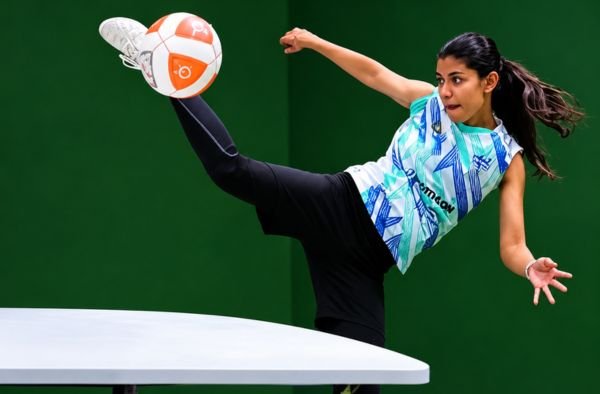
The achievement carries added significance because teqball is making its Asian Games debut in Aichi-Nagoya. The Olympic Council of Asia officially added teqball to the Games programme in March, alongside padel, taking the number of sports at the 2026 edition to 43. For Dsouza, the opportunity is now very real.
Dsouza survives a thriller in the opening match. Her campaign began against home favourite Yuina Sakamoto, the top seed in the group, at the Nagoya City Higashi Sports Center. The Indian had to fight from behind after dropping the opening game 10-12. Instead of allowing the momentum to disappear, Dsouza responded with remarkable composure, edging the second game 12-11 before clinching the deciding game 13-11.
The 43-minute contest was decided by the smallest of margins, with Dsouza holding her nerve when the pressure was at its highest. Her second group match proved considerably more straightforward. She defeated Cambodia’s Koemyean Dy 12-9, 12-7 in just 24 minutes, completing a two-match winning record and securing top spot in Group B. That group-topping finish proved decisive. Rather than entering the quarterfinal stage, Dsouza received a bye and advanced directly into the semifinals, leaving her just one match away from a place on the podium.
Indonesia stands between Dsouza and history. The next test comes on Saturday against Indonesia’s Sumaya. Victory will guarantee Dsouza at least a bronze medal and make her India’s first teqball medallist at the Asian Games. A defeat, however, will not immediately end her medal hopes. She would receive another opportunity in the bronze medal match on Sunday against the loser of the other semifinal between Myanmar’s Wai Khin Hin and Lebanon’s Kamar Dandal. The route is therefore clear, but the pressure is increasing with every point.
A sport built around football skills. Teqball is one of the fastest-growing football-based sports in the world. Played on a specially designed curved table, competitors use their feet, knees, chest and head to return a football over the net. The sport demands a combination of football technique, balance, coordination and rapid reactions.
Players are also required to adapt to the unusual trajectory created by the curved playing surface. Its inclusion at Aichi-Nagoya represents another step in the sport’s international development. It has previously featured at the European Games and other international multi-sport competitions, while its inclusion in the Asian Games gives it a significantly larger continental platform.
India’s wider teqball campaign also has another medal possibility. Dsouza and Mohammed Anas Imran Beg remain in contention in the mixed doubles event through the repechage route. For Indian sport, Dsouza’s run is significant beyond the medal table. Much of India’s Asian Games attention naturally falls on athletics, shooting, wrestling, boxing, badminton and cricket.
Yet the country’s 2026 campaign also offers opportunities in newer disciplines, and teqball has already shown why those additions matter. India sent 492 athletes to Aichi-Nagoya, with the country coming off a record 107-medal haul at the Hangzhou Asian Games. Now, a relatively unfamiliar sport has given India another potential medal story. For Dsouza, Saturday is no longer about simply making a strong debut. It is about standing on the edge of history.

