

Quincy Dsouza was three points away from putting India into a historic Teqball final. Instead, an extraordinary Indonesian fightback turned a promising semifinal into a painful defeat, leaving the Indian with one final opportunity to bring home a medal from Teqball’s Asian Games debut. D’Souza went down 7-12, 12-9, 12-7 to Indonesia’s Ima Sumaya at the Nagoya City Higashi Sports Centre on Saturday, despite taking control early and leading 7-3 in the deciding set.
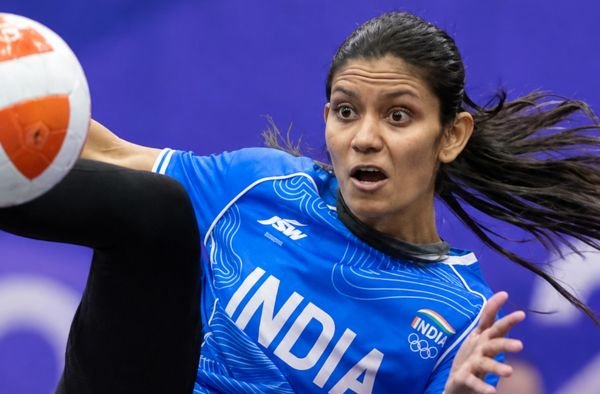
Sumaya’s nine-point unanswered surge in the decider changed the match completely and sent the Indonesian into Sunday’s gold medal match against Myanmar’s Khin Hnin Wai. For D’Souza, the defeat was a reminder of how quickly momentum can disappear in Teqball, a sport built around precision, touch and rapid changes of direction. The Indian had looked firmly in control during the opening stages and took the first set 12-7, using the curved table to create difficult angles and repeatedly finding gaps in Sumaya’s defence.
Sumaya, however, refused to allow the match to run on D’Souza’s terms. The Indonesian began to find her rhythm in the second set, particularly as D’Souza’s early advantage disappeared. The Indian had opportunities to regain control, but Sumaya kept extending rallies and eventually closed out the second set 12-9 to force a decider.
The third set appeared to be heading D’Souza’s way again. She opened with a 3-0 advantage and stretched that lead to 7-3, putting herself within touching distance of the final. But that was where the momentum swung dramatically. Sumaya produced nine consecutive points to move from 3-7 down to 12-7, completing one of the most significant comebacks of the opening Teqball competition at the Games.
The result means Sumaya is guaranteed at least a silver medal, while D’Souza must regroup quickly for the bronze medal match on Sunday. Standing between her and a place on the podium will be Japan’s Yuina Sakamoto, the player D’Souza has already beaten once in Nagoya.
That victory came in the opening group match and was arguably the first major statement of India’s Teqball campaign. D’Souza overcame the top-seeded Sakamoto 10-12, 12-11, 13-11 in a tightly contested encounter before following it up with a straight-sets win over Cambodia’s Koemyean Dy. Those results saw her top Group A and move directly into the semifinals without having to play a quarterfinal. The bronze medal contest therefore offers a fascinating second meeting between the two players.
Sakamoto will have the home crowd behind her, but D’Souza will enter with the psychological advantage of knowing she has already found a way past the Japanese player. The Indian’s earlier victory was also far from straightforward, with Sakamoto taking the opening set before D’Souza edged the second and third. A victory on Sunday would have significance beyond D’Souza herself. Teqball is making its Asian Games debut in Aichi-Nagoya, with the sport combining football skills with a curved table and allowing players to use their feet, legs, head and torso rather than their hands and arms. Five medal events are being contested in the discipline.
D’Souza’s own route into the sport makes her campaign even more notable. The Mumbai-born athlete previously competed in middle-distance running and football before discovering Teqball after watching Brazilian football great Ronaldinho play the sport. She began playing in 2022 and has since become a seven-time national champion. Her run has also helped bring attention to a sport still developing in India. Reports have highlighted the relatively small domestic Teqball ecosystem, with around 180 registered players, making D’Souza’s semifinal appearance particularly significant for the sport’s visibility in the country.
The semifinal defeat hurts because D’Souza had the match in her hands. But it has also shown why her campaign matters beyond one result. India has traditionally built its Asian Games medal hopes around established Olympic disciplines. Teqball represents something different. It is new, relatively unfamiliar to the Indian sporting audience and still developing its competitive infrastructure.
D’Souza has already become one of the faces of that new chapter. The defeat to Sumaya should not erase what came before it. She upset the top seed, topped her group and reached the last four in the sport’s first appearance at the Asian Games. More importantly, she now gets another opportunity to turn an impressive debut into a podium finish.

