

For years, Indian badminton has searched for the next wave after the era dominated by stars such as Saina Nehwal and PV Sindhu. The question has never been whether India possesses talent, but whether that talent can consistently translate promise into performances on the international circuit. At the Taipei Open, Unnati Hooda is once again providing an encouraging answer.
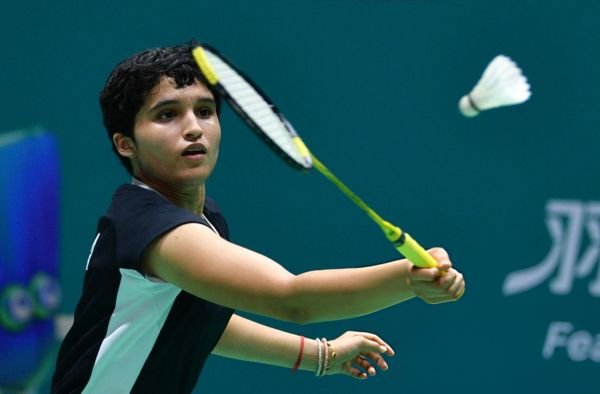
The 18-year-old booked her place in the women’s singles semifinals of the Taipei Open with a composed 23-21, 21-16 victory over compatriot Devika Sihag in an all-Indian quarterfinal on Friday. It is not merely another semifinal appearance.
It is the second consecutive year that Hooda has reached the last four of the BWF World Tour Super 300 event, underlining that her breakthrough in 2025 was no one-off achievement but part of a steadily growing trajectory. The Taipei Open, held at the Taipei Arena in Chinese Taipei, remains one of the key Super 300 tournaments on the BWF calendar, attracting a competitive international field.
What stood out against Sihag was not just Hooda’s shot-making but her temperament. She stormed to an 11-3 advantage in the opening game, only to see Sihag claw her way back and level proceedings at 21-21. Many young players struggle when momentum swings so dramatically. Hooda did not. She responded by winning the next two points, taking the game 23-21 with the calmness of a far more experienced campaigner.
That composure carried into the second game. The third seed dictated the rallies, managed the pace effectively and converted her advantage into a convincing 21-16 victory in just 42 minutes. Against a determined eighth-seeded Sihag, Hooda looked increasingly like a player learning how to win rather than merely compete.
The significance of the all-Indian quarterfinal extended beyond the result itself. It guaranteed India a women’s singles semifinalist before a shuttle had even been struck, highlighting the country’s growing depth in the discipline. While established names continue to carry expectations at the highest level, the emergence of players like Hooda, Sihag, Tanvi Sharma and Anmol Kharb suggests that India’s women’s badminton pipeline is becoming increasingly robust.
Hooda’s consistency is particularly noteworthy. Last year, she reached the semifinals in Taipei before falling to Japan’s top seed Tomoka Miyazaki, one of the brightest young talents in world badminton. That campaign announced her arrival. Returning to the same stage a year later demonstrates maturity, adaptability and an ability to handle expectations that often burden young athletes.
The teenager’s rise has been gradual rather than spectacular, and perhaps that is precisely why it deserves attention. She has accumulated experience across BWF Tour events, steadily improving her ranking and exposing herself to increasingly demanding opposition. In an era where young athletes are often judged by instant success, Hooda’s development reflects the value of patience, structured coaching and sustained exposure to elite competition.
Her semifinal opponent will emerge from the clash between Chinese Taipei’s Chiu Pin-chian and Vietnam’s Nguyen Thuy Linh, another stern examination of her credentials. Regardless of the outcome, Hooda has already reinforced an important message. She belongs at this level.
India’s campaign in Taipei is far from over. Later in the tournament, Tanvi Sharma and Kiran George are scheduled to contest their respective singles quarterfinals against Thailand’s Supanida Katethong and Japan’s Yudai Okimoto, giving India further opportunities to make deep runs across the draw.
Indian badminton has often celebrated isolated champions. What it now appears to be building is something far more valuable: continuity. Unnati Hooda’s latest semifinal is not simply another result on the tournament sheet. It is another reminder that the country’s next generation is no longer waiting in the wings. They have already stepped onto the biggest stages, and they are beginning to make them their own.

