

Recently, Indian cricketer Shreyanka Patil opened up about the trolling she faced over her social media presence during India Today’s Karnataka Roundtable. The youngster had shared a video of herself dancing to the song ‘Babli Badmaash Hai’; she received a lot of backlash over it on social media. Speaking to India Today’s Rajdeep Sardesai at the Karnataka Roundtable, Shreyanka mentioned she’s not affected by the attention and does not view it with a negative outlook, insisting both criticism and appreciation keep her in the conversation.
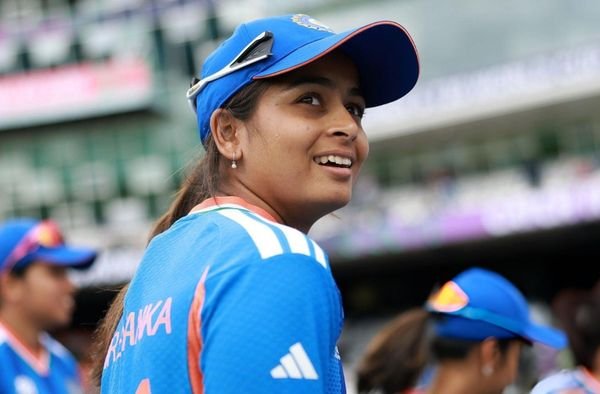
“I mean, honestly, it gives me a lot of attention. People are actually seeing me and saying, ‘Oh, she’s doing so well.’ Whether you troll me, criticise me or appreciate me, I think it’s all for my good. I don’t see trolls as trolls because I love what I’m doing. I love being on Instagram, I love dancing, and I love wearing the dresses I want to wear,” Shreyanka said.
“I’m not shy about saying that because I’m comfortable with who I am. I’m comfortable dancing to any song and doing what makes me happy. I love doing what I love, and trolls are just going to remain trolls. They’re probably just jealous that I’m doing well,” Shreyanka said.
Patil further mentioned that she’s happy with her choices and does not allow negative comments to dictate her preferred way of self-expression. She prefers to focus on things which bring her joy rather than worrying about her critics.
However, that’s not the complete gist of what happened. At the same event, Patil was asked to recreate those steps in front of everyone. Ask yourself: would a male cricketer or any male athlete be asked to dance on the stage at a formal event? The answer almost always would be no. When people in charge at events like these are supposed to be responsible for the professional conduct and integrity of the event but deviate from that point, these are the results.
Male athletes are allowed to have a life outside the sport and are often even praised for showing off their personality, and their commitment to the sport or their achievements are never questioned. But that’s not just true in sports, is it? It’s rooted in the basic structure of our society. Women are questioned based on the most trivial things, while males will be praised for it in the same breath. Women’s sports are viewed and treated as a privilege that is granted to them, rather than something that was earned, with perhaps even more obstacles in the context of opportunities available. Perhaps this is why they’re expected to exhibit their love for the sport at all times, and personal hobbies are viewed as offensive, and at times as taboo.
Take Indian cricketer Yuzvendra Chahal, for example, who often posts dance reels or comedic skits, and his presence or actions are seen as lighthearted and relatable. So what is so different that Patil is partaking outside the pitch that it’s offensive or shameful? Is it the oversexualisation of the entire act of dancing by the collective society? Or that female athletes or females in general should simply be only committed to their work 24/7? Another example would be when, during the 2025 ICC Women’s ODI World Cup held in India, Shreyanka’s compatriot, Jemimah Rodrigues, was similarly trolled for having a social media presence, but fortunately their relevance was as quickly over as it began after Rodrigues’ semifinal performance against Australia, where she scored 127* not out.
The media is as responsible for this as everyone else. At professional sporting events, women are asked to showcase their outfits, answer personal questions, and do anything that showcases their femininity but pushes them further away from their athlete identity. Younger players like Shreyanka Patil represent a new era for athletes who use digital platforms to build their identity outside the sport, construct their personal brands, and to even connect with fans beyond the stadiums.
But perhaps the best thing today is that female athletes like Shreyanka Patil refuse to shrink or apologise for their hobbies. This unapologetic attitude is exactly what marks a turning moment in women’s sports culture.
To conclude, we’d say that sports can truly be equal when a female athlete isn’t having her character questioned just because she chose to post a reel of herself dancing or chose to portray her fashion, and she gets the same freedom male athletes are entitled to exist off the field. An athlete’s integrity in their sport isn’t compromised just because they dance in their personal time. Instead, it’s the media authorities and the public’s professionalism that should be scrutinized when they ask someone to dance and then troll them.

