

Jenni Hermoso’s return to Atlético Madrid should not be reduced to nostalgia or another late-career transfer. After becoming the central figure in one of football’s biggest institutional controversies, her decision to return to the club where her career began represents something more powerful: the reclaiming of her own story. Football has a habit of remembering moments differently from the people who lived them.
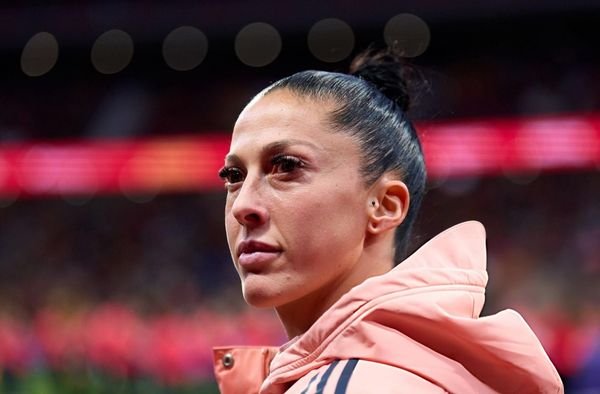
For Jenni Hermoso, the defining images of recent years have often had little to do with her football. The World Cup winner became synonymous with the controversy that followed Spain’s triumph in 2023, when then Spanish football federation president Luis Rubiales kissed her on the mouth without her consent during the medal ceremony.
But now, at 36, Hermoso has chosen to put football back at the centre of her story. The Spanish forward is returning to Atlético Madrid for a third spell, signing until June 2027 after leaving Mexican side Tigres Femenil earlier this month. The move takes her back to the club where she first began making her name and where she helped create one of the most significant chapters in Atlético’s women’s football history. “I have been lucky enough to choose where I want to be and today I feel privileged to say that I am in the place I want to be,” Hermoso said.
That sentence may be the most important part of this transfer. Hermoso joined Atlético’s academy at just 12 and eventually made her first-team debut in 2006. She even scored the goal that helped Atlético secure promotion to Spain’s top division. Her journey subsequently took her to Rayo Vallecano, Barcelona, Paris Saint-Germain, Tyresö and Mexico, establishing her as one of the most accomplished forwards of her generation.
Her second spell at Atlético was particularly important. She returned in 2018 and played a major role in the club’s 2018-19 league triumph, scoring 24 goals and finishing as the competition’s top scorer. That title remains the last time a club other than Barcelona won Spain’s top women’s league, underlining just how dominant Barcelona have become in the domestic game.
Hermoso’s return, therefore, is not simply a sentimental reunion. It is Atlético bringing back a player who already knows what it takes to challenge the established order. And that is precisely what makes the timing interesting. Spanish women’s football has changed dramatically since Hermoso first emerged. Barcelona have transformed themselves into one of the strongest clubs in world football, while the growth of Liga F has increased the visibility and competitiveness of the domestic game.
Atlético now have to find a way to close that gap. Hermoso cannot be expected to reproduce the numbers of her peak years indefinitely. At 36, the calculation is different. Her value is now measured through experience, movement, finishing, leadership and the ability to influence younger players as much as through goals.
But there is another dimension to her return that cannot be ignored. The 2023 World Cup was supposed to be the crowning moment of a remarkable Spanish generation. Instead, the celebrations were overshadowed by the Rubiales controversy. Hermoso’s testimony and subsequent public stance helped force a conversation that extended far beyond football.
In February 2025, Spain’s High Court found Rubiales guilty of sexual assault over the non-consensual kiss and fined him more than €10,000. The court also imposed a one-year restraining order and ordered him to compensate Hermoso €3,000.
The Court of Arbitration for Sport also upheld FIFA’s three-year ban on Rubiales, finding his conduct constituted a serious violation of the FIFA Disciplinary Code. Those developments matter because Hermoso’s career could easily have become defined by what happened to her.
Instead, she has continued playing. She moved to Mexico, played for Pachuca and Tigres, remained a prominent figure in Spanish football and has now returned to Madrid. That is the editorial significance of this transfer. Hermoso is not returning to Atlético to revisit the past. She is returning because she still has a future in football.
Atlético themselves have made it clear that they see her as an attacking reinforcement rather than merely a ceremonial signing. The club describes her as a player bringing extensive domestic and international experience, with a career that includes two UEFA Nations League titles and the 2023 World Cup.
Those questions will be answered on the pitch. But before the first goal, the first assist or the first big performance, there is something else worth recognising. Hermoso has returned to the place where her professional story began. She is returning not as the 16-year-old who helped Atlético reach the top division, nor simply as the prolific striker who helped deliver the 2019 league title.
She returns as a World Cup winner, a veteran of international football and a player who has endured a level of scrutiny that few athletes ever experience. And perhaps the most fitting ending to this chapter is that the woman who once helped build Atlético’s history is back to write another page of it herself.

