

Iga Swiatek arrives in New York without the aura of inevitability that once surrounded her. For a player accustomed to measuring seasons in Grand Slam trophies, 2026 has been unusually uncomfortable.
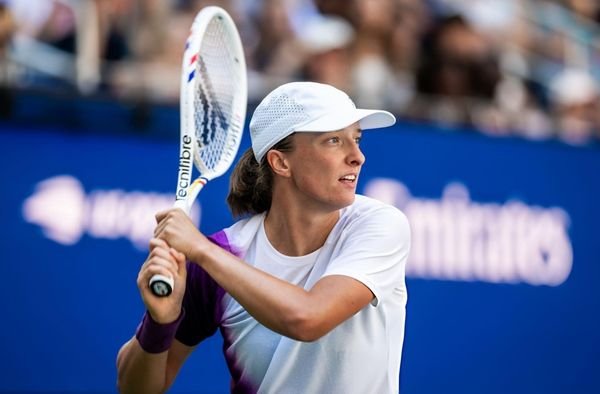
Yet that may be precisely why this US Open could become an important chapter in her career. Swiatek is no longer chasing perfection. She is trying to rediscover the player who made perfection look possible. For much of the past few years, Iga Swiatek entered Grand Slams with an expectation that was almost as heavy as the trophy itself.
She was supposed to win. Clay was supposed to belong to her. Roland Garros was supposed to be her territory. Hard courts were supposed to offer another opportunity to display the relentless baseline tennis that had taken her to the top of women’s tennis. But 2026 has stripped away much of that certainty.
The six-time Grand Slam champion heads into the US Open ranked eighth in the world after a first half of the season that, by her own admission, became the toughest of her career. She reached the Australian Open quarterfinals, exited Roland Garros in the fourth round and was eliminated in the third round at Wimbledon.
For a player who had won at least one Grand Slam in every season since 2022, those results represented more than disappointing tournament exits. They suggested that something fundamental had shifted. “For me, for sure, it wasn’t an easy season,” Swiatek said on Saturday. “Probably the toughest one and the most challenging.
“Obviously, I had to change coaches before the clay court season, which was a tricky situation. Then I started working with Francis (Francisco Roig) and just wanted to implement all the stuff that we did in practice.
“But, on the other hand, I didn’t have a lot of practice time. So probably it calmed down; everything calmed down after Wimbledon. I managed to get some days off and reset a little bit, and we had a much longer training block. So, it really helped me to just implement this stuff that I was talking about.”
That is the real story of Swiatek’s US Open campaign: not redemption, but reconstruction. The coaching change from Wim Fissette to Francisco Roig came at a difficult point in the season. Changing a coach is never merely about introducing new drills. It involves changing communication, tactical thinking and sometimes even the way a player understands her own game.
Swiatek needed time to make those changes meaningful. That time appears to have arrived after Wimbledon. Toronto provided the first convincing evidence. Swiatek defeated Elena Rybakina 6-2, 6-3 in the Canadian Open final to claim her first title of 2026 and her 26th career title. It was also her 12th WTA 1000 crown, moving her into second place behind Serena Williams for most WTA 1000 titles since the format began.
More importantly, the victory was not manufactured through survival. It was authoritative. Swiatek controlled the final against one of the biggest hitters in women’s tennis and produced the kind of performance that reminded everyone why she remains one of the most dangerous players in the draw.
“The last two tournaments (Canadian Open and Cincinnati Open) were super positive,” she said. “Even though I lost in Cincinnati, this match against Jess (Jessica Pegula in the semifinals) was really high level. So, I feel happy with my game and with the changes that I made. Just looking forward now.” Cincinnati strengthened that argument.
Swiatek reached the semifinals and pushed Jessica Pegula through a nearly three-hour contest before losing 7-5, 4-6, 6-4. The defeat ended Swiatek’s 10-match winning streak, but the quality and competitiveness of the match offered something almost as valuable as another title.
She was competing again rather than merely searching for form. A player coming off a difficult season does not necessarily need to win every match before a Grand Slam. She needs evidence that her game can survive difficult matches. Her record in New York makes the answer intriguing. Swiatek won her first US Open title in 2022, defeating Ons Jabeur in the final. Yet she has not gone beyond the quarterfinals in either of the last two editions. This year’s draw is also far from straightforward.
The women’s field is unusually open, with defending champion Aryna Sabalenka entering amid questions over her recent form, Rybakina dealing with an injury concern and Coco Gauff arriving as another serious contender after winning Cincinnati. Mirra Andreeva, the 2026 Roland Garros champion, and Wimbledon winner Linda Noskova add further unpredictability.
Her opening opponent is China’s Wang Xiyu, and the immediate objective should be simple: establish rhythm, protect the improvements made during the North American hard-court swing and avoid turning every match into a referendum on her season. Because that is another danger for a player of Swiatek’s stature.
When expectations become too high, every defeat begins to look like evidence of decline. But tennis careers are rarely that linear. Champions lose. Coaches change. Rankings fall. Confidence disappears and returns.
The important question is what a player learns during that process. Swiatek’s 2026 season has already forced her to confront uncomfortable questions about her game. The encouraging part is that she has not responded by abandoning the identity that made her successful.
And perhaps Swiatek does not need to leave New York with a seventh Grand Slam title to prove that she is back. She needs to leave knowing that the difficult months taught her how to become dangerous again. Because the most important version of Iga Swiatek is not the one who expects to win every tournament.
It is the one who knows she can lose, adjust, rebuild and still return to the biggest stage believing she belongs there. That belief, more than any ranking, streak or trophy, could determine how far she goes in New York.

