

India’s junior women have reached the stage where potential must start producing pressure performances. The UK tour has given them exposure, Tim White has given them a new framework, and Khaidem Shileima Chanu has been entrusted with leadership. Now comes the difficult part: proving that this generation can compete with Asia’s best and build a pipeline strong enough to eventually sustain the senior team. There comes a point in every promising team’s development when preparation has to give way to examination.
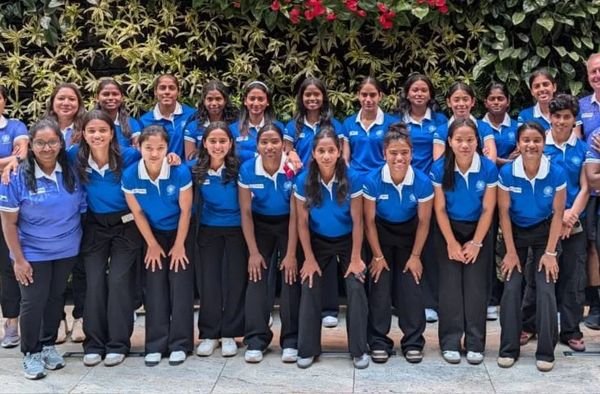
For India’s junior women’s hockey team, that moment arrives in Moqi, China. Led by midfielder Khaidem Shileima Chanu, India will begin its campaign against South Korea in the AHF Women’s Junior Asia Cup on September 4, entering a tournament that should be viewed as considerably more important than its age-group tag suggests.
This is not simply about winning a junior continental title. It is about identifying the players who can eventually carry Indian women’s hockey into its next generation. India have been drawn alongside hosts China, Japan, South Korea and Malaysia in the Elite Pool, giving the young side little room for comfortable matches. The tournament runs until September 13, with the gold-medal match providing the final examination.
The preparation, at least on paper, has been ambitious. Newly appointed head coach Tim White has overseen an extended programme that included an exposure tour of the United Kingdom in July, followed by a series of matches against a combined India A side in Bengaluru. The objective has been clear: expose the players to different styles, increase their match awareness and ensure that they arrive in China having already experienced competitive pressure.
“The team is very excited to leave for China tomorrow for the Asia Cup. Our preparation has been good, including important matches against a combined India A team, which came to Bangalore for four matches. We will go to China confident that we have built a game plan which can be hard to play against, and we are very excited to test that against the best teams in Asia,” White said.
That final sentence is perhaps the most revealing. Test that against the best teams in Asia. That should be the real purpose of this campaign. India does not need another junior tournament in which impressive scorelines against weaker opposition create a false sense of progress. It needs matches that expose weaknesses, force players to make decisions under pressure and reveal who can cope when the game becomes uncomfortable. The UK tour appears to have been designed precisely for that reason.
From July 5 to 14, India trained and played in Edinburgh and Lilleshall, taking on Scotland’s senior team as well as junior sides from the United States, England and Belgium. The results were encouraging. India defeated the United States 6-0, recorded successive 2-0 wins over England and also beat the USA in a shootout after a 1-1 draw.
But the value of such a tour cannot be measured solely through the scoreboard. Playing against Scotland’s senior team, for instance, gives a young player something that domestic junior competition cannot easily replicate: the experience of confronting physically mature opponents who punish mistakes immediately.
That kind of exposure matters because the transition from junior to senior hockey is notoriously unforgiving. The International Hockey Federation describes the Junior World Cup as a key stepping stone for players moving towards the international senior game, with the tournament bringing together the best Under-21 teams in the world.
India’s own recent history underlines the importance of this pathway. The previous Junior Asia Cup campaign produced a memorable moment when India defeated South Korea 2-1 in the 2023 final to claim the title. Yet success at junior level does not automatically translate into senior success.
That is the challenge White and his coaching staff must confront. India has traditionally produced talented young players. The harder task has been ensuring that enough of them make the jump from potential to international reliability. The current squad therefore has to be judged not just by whether it reaches the final, but by how it responds to adversity.
South Korea is an immediate test. Then comes Malaysia on September 6, Japan on September 8 and China on September 9. There is little breathing room, and the sequence is useful because each match can provide a different tactical problem. Japan traditionally brings speed and technical precision. South Korea can test India’s organisation and defensive discipline, while China, playing at home, will bring the additional pressure of a partisan environment.
For captain Khaidem Shileima Chanu, the responsibility is equally significant. Leadership at junior level is not simply about wearing the armband. It is about keeping a team composed when the opposition scores first, ensuring that the tactical plan survives pressure and making sure younger players do not disappear when the game becomes physically demanding.
That is where India’s UK experience could become valuable. A young player who has already played against senior opposition in unfamiliar surroundings is better equipped to understand that international hockey is not won by talent alone. And increasingly, it is won through the ability to remain calm when the tactical plan begins to unravel.
The India A matches in Bengaluru should have added another layer to that preparation. Playing against older and more experienced Indian players can provide an entirely different challenge from facing overseas opposition. It forces juniors to compete against players who understand India’s own systems, habits and patterns.
That internal competition is healthy. The danger, however, is allowing preparation itself to become the achievement. India has done the tours. India has played the matches. India has worked on the game plan. Now the players have to execute it. That is where this Junior Asia Cup becomes a genuine marker of progress. A medal would obviously matter.
A title would be even better. But the more important outcome could be the emergence of five or six players who demonstrate that they are ready for the next level. The senior women’s team has already shown how valuable a strong pipeline can be. Recent generations have produced players who moved from junior international hockey into major senior tournaments and eventually became central figures in India’s rise.
The current crop now has the same opportunity. And White appears to understand that the best way forward is not to shield young players from difficult situations, but to expose them to them. “We will go to China confident that we have built a game plan which can be hard to play against, and we are very excited to test that against the best teams in Asia,” he said. The phrase “hard to play against” should become the identity of this Indian team.
That means India must defend together, attack with purpose, recover quickly after mistakes and maintain composure when the opposition refuses to cooperate with the script. The Junior Asia Cup is therefore less about predicting who will win the gold medal and more about discovering who is ready for the next chapter. The players in China are not only representing India’s junior team. They are auditioning for the senior one. And if this generation can turn its preparation into performance, the biggest victory may come long after September 13.
It may come when these young players walk into a senior international stadium and no longer look like prospects.

