

The real lesson from Pirmin Blaak’s assessment is not simply that India has found a promising goalkeeper in Bichu Devi. It is that Indian hockey has finally produced a succession story built on mentorship rather than insecurity. Savita Punia is not protecting her place. She is helping prepare the player who could eventually take it. For the men, the absence of PR Sreejesh has exposed precisely how difficult it is to replace a goalkeeper whose influence extended far beyond the goalpost. Goalkeeping is perhaps the one position in hockey where succession is never simply about finding the next player with quick reflexes.
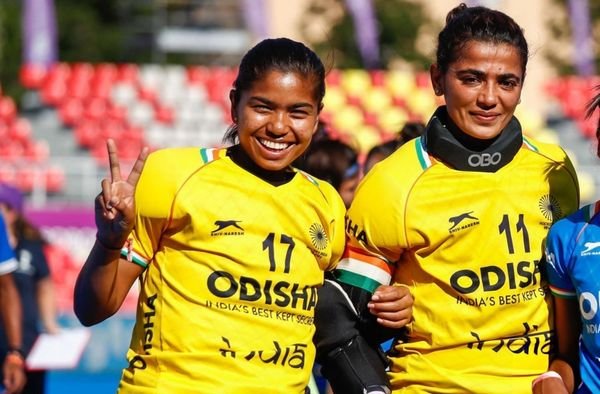
It is about finding someone who can command a defence, absorb pressure, make decisions in fractions of a second and, perhaps most importantly, convince an entire team that everything behind them is under control. That is why Pirmin Blaak’s observations about Indian hockey deserve to be read as more than a compliment to Savita Punia and Bichu Devi. The legendary Dutch goalkeeper has identified something that Indian women’s hockey may be getting right at precisely the moment when the men’s team is struggling to fill the enormous space left behind by PR Sreejesh.
Blaak, a member of the Netherlands’ Paris Olympic gold medal-winning side and a goalkeeper with more than 150 international appearances, spent a short period working with the Indian women’s team ahead of the World Cup. What struck him was not merely the technical ability of Savita and Bichu, but the relationship between them. “I love the way they help each other. It was not there during my career and I can also learn as a trainer with them. They are really nice, friendly people and that’s what I like the most,” Blaak said.
That relationship could prove to be one of India’s most valuable assets. Goalkeeping is inherently competitive. There is generally one starting position, one goalkeeper who gets the majority of the minutes and another waiting for an opportunity. That can easily create an environment where experience becomes territorial and youth becomes impatient.
India’s women appear to be avoiding that trap. “It is very rare that two players are not competing but rather they are helping each other. I asked them, ‘Are you serious, you are not competing with each other?’,” Blaak said. The answer to that question may explain why India’s transition between generations has looked considerably healthier. Savita has been India’s first-choice goalkeeper for more than a decade. Her career has been built through major tournaments, pressure situations and the expectations that come with being one of the most recognisable players in Indian women’s hockey. Yet instead of treating Bichu as a threat, she appears to be treating her as a successor worth preparing.
“What Savita was setting up for the last decade is incredible. It is nice that she herself is preparing Bichu to come through. “It will be really nice if they can play together for some time, where Savita opens up and says that I am going to retire soon and I am giving that last push to Bichu to help her. It is nice to have an experienced goalkeeper besides a younger one,” Blaak said. There is a powerful lesson here for Indian sport. A successful transition does not necessarily mean replacing a legend overnight. Sometimes, the best transition happens when the legend stays long enough to teach the next generation how to carry the responsibility.
India’s recent World Cup campaign offered evidence that this model can work. The women’s team finished with its best World Cup result in more than five decades, while Bichu and Savita were both used during the tournament. India began with a 2-2 draw against Olympic silver medallists China, defeated South Africa 6-1 and held England to a goalless draw to progress to the second round. They eventually missed the semi-finals but secured a historic fifth-place finish. Bichu, in particular, produced important moments under pressure. Against England, she made a tournament-defining save in the final minute to preserve India’s qualification hopes.
That is where Blaak’s argument becomes particularly relevant. “I haven’t changed anything tactically. I just discussed where we want to grow and what my vision is. I keep them the way they are. They are brilliant and unique in their style of play,” he said. His approach was not about rebuilding two goalkeepers in a fortnight. It was about strengthening the mental side of the position. “Savita and I also talk about the pressure to perform on Team India. I understand that. I have been in those moments and Savita has also experienced that. “In two weeks’ time we cannot change anything, but I talked to them about these aspects. I think mental side is one of the most important things in goalkeeping,” he said.
That may be the most important observation of all. India’s problem with Sreejesh was never going to be solved by simply finding another goalkeeper with similar technical numbers. Sreejesh was a presence. He communicated, organised, challenged, encouraged and, when required, imposed himself on the opposition. “I watched the men’s team also and there is a huge gap after the legendary PR Sreejesh retired. The big-status goalkeeper. Young goalkeepers have come but they lacked the quality to push India to the next level,” Blaak said.
And then came the crucial distinction. “Sreejesh has a big legacy. I feel some similarity with him. We had something with our body language like we are there. He was really outspoken. A goalkeeper should make a difference and it seems to be missing,” he added. The timing of Blaak’s comments is telling. India’s men’s team entered the 2026 World Cup carrying expectations created by its Olympic successes, but its campaign ended before the semi-finals. Sreejesh himself has subsequently questioned whether India is building a team capable of beating the world’s best rather than simply producing respectable performances.
That is where the contrast between the two teams becomes difficult to ignore. The women’s side is not trying to find another Savita. It is allowing Bichu to become Bichu. The men’s side cannot find another Sreejesh because there will not be another Sreejesh. That distinction matters.
India’s young men’s goalkeepers, Mohith HS and Suraj Karkera, need to develop their own identity rather than attempt to replicate a player who spent years establishing his own. Blaak’s advice is therefore less about technique and more about planning. “You have great coaching staff, legends like Sreejesh, so just come together and plan what you really need. You need to chart out a strategy and follow that,” he said.
Even the Netherlands, despite their extraordinary dominance, do not treat success as automatic. “The Netherlands also could not win a World Cup for 24 years now. We have won a Pro League but we see the Pro League leg as an internal stage. You need to play the semifinals and finals of the World Cup and Olympics. That’s where we have to be always and our coaches think about every aspect – technical, mental and behavioural part.”
That is perhaps the broader lesson Indian hockey should take from Blaak. “For a World Cup, smartness and mental preparation are very important,” he said. India’s women have shown signs of understanding that principle. Their goalkeeping department is not merely preparing for the next match. It appears to be preparing for the next generation. The men, meanwhile, are discovering how expensive it can be to wait until a legend retires before seriously confronting the question of succession. Sreejesh’s legacy was never going to be replaced in a single tournament. But it can be followed by another legacy.
And if the women can prove that a goalkeeper’s greatest contribution may sometimes be preparing the person who eventually replaces her, Indian hockey should pay attention.

