

The global conversation around fairness and inclusion in sport has taken a new turn following the International Olympic Committee’s updated gender eligibility framework. With stricter regulations now proposed for participation in women’s categories, the debate has drawn responses from athletes across generations. Among them is Croatian high jump legend Blanka Vlasic, who has voiced support for clear and consistent rules to safeguard competitive balance.
The new policy introduced by the International Olympic Committee proposes that eligibility for women’s events across all Olympic disciplines will be determined through SRY gene screening. The move is aimed at standardising criteria for participation, but it has also sparked widespread discussion on its implications for athletes and the broader sporting ecosystem.
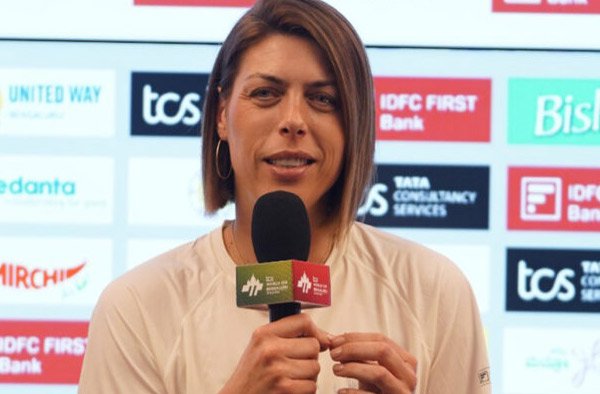
Speaking during her visit to Bengaluru, where she is serving as the international ambassador for the TCS World 10K Bengaluru 2026, Vlasic shared her perspective on the issue. A two-time world champion and one of the most accomplished high jumpers in history, she emphasised the need for uniform standards in elite sport. “In sport, there should be strict policies. Things should be clear. Everybody competing should compete under the same standards, and have the same conditions. Women’s sport should be protected in that way,” Blanka said here on Thursday.
Vlasic’s remarks reflect the concerns of many athletes who believe that clarity in regulations is essential to maintaining fairness in competition. While the policy continues to generate differing opinions globally, her stance highlights a viewpoint rooted in preserving the integrity of women’s sport.
Over the course of her career, Vlasic established herself as a dominant force in high jump. Alongside her two world championship gold medals, she also claimed two world indoor titles, three World Athletics Final victories, and Olympic medals at both the 2008 Beijing Olympics and the 2016 Rio Olympics. Her personal best of 2.08 metres, achieved in 2009, remains one of the highest jumps ever recorded in women’s athletics.
Beyond her achievements, Vlasic has long been an advocate for clean sport. Competing in an era where performance standards were constantly rising, she took pride in maintaining integrity throughout her career.
“I’m proud to have been part of the generation that jumped really, really high, and under the motto – ‘We jump clean’,” Blanka, who towers over the room at 6’4”, said. Her emphasis on ethical competition extends to her views on success itself. Vlasic believes that sustained excellence, rather than fleeting triumphs, defines a true champion.
“If you achieve success with shortcuts, then your success will probably be just one spark. But in sports, do you remember someone who won just one time? Or do you remember a champion who was present for 10 years, with his or her ups and downs? I was consistent for so many years in a highly competitive sport – that was the goal,” she said.
Consistency, she argues, is one of the most undervalued markers of greatness in athletics. While medals and records often dominate headlines, longevity at the top level requires discipline, resilience, and adaptability.
“In track and field, it is very important to maintain your level for a long period of time. That is what is valued. Even if you are not an Olympic gold medallist or world champion, if you are consistently in the top 10 in the world for more than 10 years, you could say that you had a great career,” Blanka said. As discussions around gender policies continue to evolve, voices like Vlasic’s bring valuable insight shaped by years of elite competition. Her perspective does not just focus on rules, but on the principles that underpin sport itself. Fairness, clarity, and integrity remain central to that vision.
With the sporting world navigating complex questions about identity and competition, the path forward will likely require both sensitivity and structure. For athletes like Blanka Vlasic, the priority remains clear. Protecting the spirit of competition while ensuring equal conditions for all participants is essential to preserving the credibility of sport at the highest level.

