

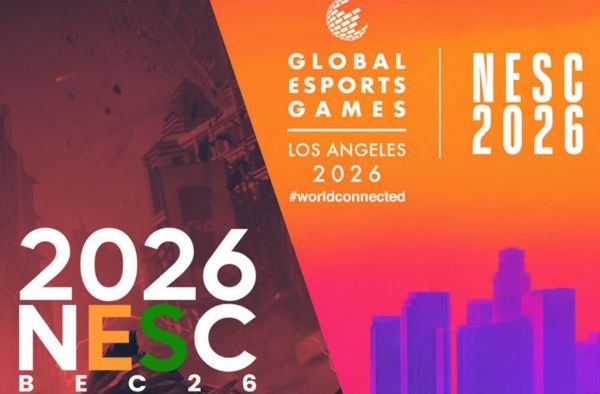
For Indian esports, the next few months are about more than medals. They are about preparation, exposure and proving that a growing pool of talent can consistently perform when the stakes move beyond the domestic circuit. The Esports Federation of India (ESFI) has announced the final Indian contingents for the BRICS Esports Championship 2026 in Moscow and the Global Esports Games 2026 in Los Angeles, following the conclusion of the National Esports Championships (NESC) on August 5.
The selections come at a particularly significant moment for Indian esports, with the Asian Games in Aichi-Nagoya just weeks away and esports set to feature as a medal sport once again. The NESC has therefore served a purpose larger than simply identifying winners. It has become an important checkpoint in India’s preparation for international competition, giving players a national platform from which they can earn their place in the country’s esports setup.
At the BRICS Esports Championship, scheduled from September 9 to 15 at VK Play Arena in Moscow and organised by the Russian Esports Federation, India will be represented by Arsalan Wani and Gurashish Singh in TEKKEN 8. Wani earned his place after winning the NESC BRICS qualifier, while Gurashish Singh secured his berth as the winner of the NESC 2026 Asian Games category. Shubham finished as the first runner-up, with Ashish taking the second runner-up position.
The selection is significant because TEKKEN 8 is also among the fighting game titles included in the esports programme at the Aichi-Nagoya Asian Games. The Asian Games will feature esports as a formal medal discipline across 11 events and 13 titles, including TEKKEN 8 as part of the fighting games programme. The esports competition is scheduled for September 23 to October 2 at Aichi Sky Expo. That proximity in the calendar makes the BRICS championship more than another international tournament. It provides Indian players with an opportunity to test their composure and tactical adaptability against international opposition immediately before the continental showpiece.
India’s record suggests there is reason for optimism, but also plenty of room for improvement. Indian esports athletes have already produced notable results at major multi-sport competitions. The country’s League of Legends team finished fifth at the 2022 Asian Games, while Indian players have also secured podium finishes at international esports events, including a silver in TEKKEN 8 at the BRICS Esports Championship and a bronze in eFootball at the Asian Esports Games 2024.
The bigger question now is whether those individual successes can become a sustained competitive pipeline. “The BRICS Esports Championship and the Global Esports Games are invaluable opportunities for our athletes as we build towards the Asian Games. Competing against some of the world’s best players reflects the growing depth of India’s esports talent while giving our athletes the exposure needed to sharpen their skills, perform under pressure and raise their competitive standards. “These experiences will play a vital role in preparing Team India for future international competitions, including the upcoming Asian Games,” said Lokesh Suji, General Secretary, Esports Federation of India and vice president, Asian Esports Federation (AESF).
The Global Esports Games will offer an even broader test. Organised by the Global Esports Federation, the Los Angeles edition is scheduled from December 1 to 7 and will bring together athletes from member federations across the world. The federation describes the GEG as its flagship competitive esports event. India’s roster reflects the increasingly diverse nature of competitive gaming. In Counter-Strike 2, Diamond Dogs secured the national berth after defeating Friedup Gaming in the grand final. The squad comprises captain Ritesh Sarda, Hrishikesh Shenoy, Gourav Panwar, Garvit Nehra and Yash Kumar Singh.
Clash Royale will see Devershi Kumar Kulhara represent India in the open category after finishing ahead of Heer Chawda and Mohamed Rizal S, while Shagun Srivastava won the women’s category ahead of Nikita S. In NBA 2K, Shubham Sharma will captain a three-member team alongside Ashutosh Kumar and Sumer Singh Sandhu.
Rocket League will feature Abhai Ponna as captain, alongside Jayanth Engineer and Aditeya Amol Srivastav. In iRacing featuring Ferrari, Yashwanth Babu topped the standings ahead of Aditya Iyer and Ankit Raj. Chinmay Sahoo has been awarded India’s open-category eFootball slot after winning the NESC 2026 Asian Games category.
What makes this moment particularly important is the changing position of esports within international sport. Its inclusion as a medal event at the Asian Games has already moved competitive gaming beyond its traditional identity as an entertainment product. Aichi-Nagoya will expand the esports programme from the seven titles seen at Hangzhou to 13 titles across 11 events.
For India, the opportunity is now to convert participation into performance. The road to becoming an esports powerhouse will not be built through one tournament or one standout player. It requires structured domestic competitions, reliable scouting systems, professional coaching, international exposure and the ability to prepare athletes for the psychological demands of representing a country. The NESC has taken another step in that direction. Moscow will provide an immediate test. Los Angeles will offer a wider international platform. And the Asian Games will ultimately provide the most important measure of whether India’s esports ecosystem is progressing from potential to performance.

