

For decades, women in sport have fought to make the conversation about what they can achieve rather than how they look. Now, a controversial advertising campaign featuring American actor Sydney Sweeney has reignited that debate, with several prominent female athletes arguing that the campaign reduces women’s relationship with sport to their bodies.
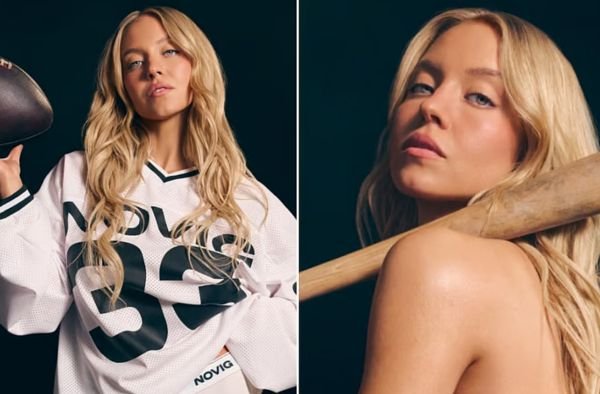
The advertisement, created for sports prediction market platform Novig, features Sweeney with little or no clothing, using footballs and other sporting equipment to cover parts of her body while adopting poses associated with different sports. The campaign has quickly become a talking point across the sporting world, with athletes questioning whether such marketing undermines years of progress made in women’s sport.
The backlash has been particularly strong because it comes at a time when women’s sport is enjoying unprecedented attention and commercial growth. Instead of celebrating female athletes for their strength, skill and competitive achievements, critics argue that the Novig campaign falls back on an old advertising formula in which the female body becomes the primary selling point.
Four-time Olympic swimming gold medallist Ariarne Titmus was among the strongest voices to condemn the campaign. “I can’t describe how infuriated I feel when I watch this,” four-time Olympic swimming gold medalist Ariarne Titmus wrote on Instagram. “How do we live in a world where monetizing a woman’s body and sexualizing women’s sport is still a thing?”
Titmus’ criticism struck at the central issue surrounding the campaign. Female athletes have historically had to navigate a complicated relationship with the media, where sporting achievements can sometimes be overshadowed by commentary about appearance, femininity and sexuality. British sprinter Amy Hunt took the issue directly into the sporting arena. Speaking to the BBC after finishing fourth in the 200 metres at the Ultimate Championship in Budapest, Hunt addressed Sweeney while looking towards the camera.
“Sydney Sweeney, this is what women in sport look like,” she said. “Muscles, hard work, sweat, blood, tears.” The simplicity of Hunt’s response captured what has become a broader reaction from athletes. Rather than attempting to compete with the imagery of the advertisement, athletes have been posting photographs and videos of themselves training, competing and celebrating their achievements, effectively turning the controversy into a showcase of what women’s sport actually looks like.
Former US gymnast Gracie Kramer also described the campaign as infuriating. “I’ve spent my entire life competing in a sport where female athletes have been oversexualized, reduced to our bodies, and forced to fight to be taken seriously for what we can actually do,” she said on Instagram. Kramer subsequently shared stories featuring female athletes training alongside the caption: “What a woman in sports looks like.”
Chinese-German rugby player Sofie Fella also joined the criticism, arguing that female athletes can provide a different kind of representation for young girls and women by breaking away from narrow expectations surrounding beauty and femininity. “And that’s why that Sydney Sweeney ad is so disrespectful to every female athlete in the world,” she said in an Instagram post.
The controversy has also prompted athletes to draw a distinction between embracing sexuality and using sexuality as the central tool to market sport. World champion boxer Skye Nicolson argued that there is nothing inherently wrong with an athlete embracing femininity, but questioned the decision to use sex as a mechanism to sell sport. The response has been significant.
The Guardian reported that the Novig commercial had been viewed more than 22 million times in its first two days, demonstrating the enormous reach the campaign achieved even as criticism mounted. Novig has not immediately responded to requests for comment, while a publicist for Sweeney also did not immediately respond to requests for comment.
Sweeney, however, appeared to address the criticism indirectly over the weekend by posting covers from ESPN The Magazine’s Body Issue, which has historically featured athletes posing nude or semi-nude while focusing on athletic bodies and physical diversity. That response adds another layer to the debate. The Body Issue has generally positioned the athlete’s body as evidence of performance, discipline and physical achievement. The criticism surrounding the Novig campaign, meanwhile, centres on whether the same imagery is being used primarily as a commercial device.
The controversy also comes after Sweeney faced significant debate over her 2025 American Eagle campaign. That campaign used the phrase “Sydney Sweeney has great jeans” while playing on the similarity between “jeans” and “genes”. Critics argued that references to Sweeney’s blonde hair and blue eyes, combined with the genetic language used in the advertisements, evoked troubling associations with eugenics.
Others dismissed the criticism as an overreaction to a provocative advertising concept. Sweeney is also no stranger to projects connected to sport. She starred in and produced “Christy”, the biographical film about American professional boxer Christy Martin, bringing the story of one of women’s boxing’s pioneering figures to a wider audience.
The real contest here is not between Sweeney and the athletes. It is between two very different ways of presenting women in sport. There is an important distinction between celebrating the athletic body and using the female body to sell a sporting product. Female athletes spend years developing strength, endurance, technique and resilience, yet their appearance continues to be part of the conversation in ways that male athletes rarely experience to the same extent.
That is why the reaction from athletes has been so pointed. Hunt’s “Muscles, hard work, sweat, blood, tears” response effectively reframes the discussion. It reminds audiences that behind every medal, record and championship performance is a body that has been trained, pushed and tested.
At the same time, Sweeney is an actor, not a professional athlete, and the campaign is advertising rather than a sporting event. The criticism therefore should not be interpreted as an argument against women choosing how they present their bodies. The more difficult question is what happens when an industry uses the imagery of sport while presenting a woman’s body as the primary spectacle.
For women’s sport, the timing makes the issue even more significant. As female competitions attract larger audiences, sponsorships and commercial investment, advertisers have an opportunity to help redefine how women athletes are seen. The athletes responding to this campaign are making it clear that they want that opportunity to be used differently.
The debate surrounding Sweeney’s Novig advertisement is therefore bigger than one campaign. It is about who controls the image of women in sport, what that image communicates to the next generation and whether commercial success should come at the cost of reducing athletic women to the bodies they have spent their lives training.

