

India’s Asian Games campaign began before the ceremonial flame was even lit, and Friday produced a mixed but eventful opening chapter for the contingent. While the women’s cricket team made a statement with an emphatic win over hosts Japan, teqball provided another reason for optimism through Quimcy D’Souza’s march into the women’s singles semi-finals.
The men’s soft tennis team, meanwhile, bowed out after a hard-fought defeat to Indonesia. With the official opening ceremony scheduled for Saturday, September 19, several competitions had already begun in Aichi-Nagoya. This early start is part of a broader Games programme featuring around 17,000 athletes and officials from 45 countries and regions across 43 sports.
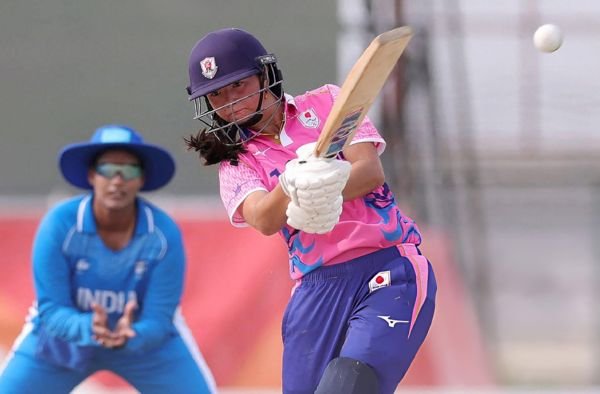
For India’s women’s cricket team, there was little drama once the contest began. Harmanpreet Kaur’s side, the defending Asian Games champions, dismantled Japan in the quarter-final, bowling the hosts out for just 57 before chasing down the target in only five overs. The architect of India’s bowling performance was left-arm spinner N Shree Charani, who returned career-best T20I figures of 4 for 10. India’s spinners squeezed Japan relentlessly, with Shafali Verma also contributing with two wickets as the hosts struggled to build any meaningful partnership.
With only 58 required, India needed just five overs to complete an eight-wicket victory. Shafali then provided the finishing burst, smashing an unbeaten 40 from only 15 deliveries. Her assault ensured that India’s pursuit was completed with 90 balls still unused, underlining the gulf between the two sides on the day. The victory sends India into the semi-finals against Bangladesh on Sunday, keeping the defending champions firmly in the hunt for another Asian Games gold medal.
The women’s T20 tournament itself began on September 17 and features eight teams, with India entering directly at the quarter-final stage. If cricket supplied India’s biggest result of the day, teqball offered one of its most intriguing stories. D’Souza, competing in the sport’s Asian Games debut, topped Group A in the women’s singles to progress directly to the semi-finals. Her campaign included a dramatic first-round victory over Japan’s Yuina Sakamoto, where she saved a match point before winning 10-12, 12-11, 13-11. She then defeated Cambodia’s Koemyean Dy 12-5, 12-6.
The 24-year-old’s journey is particularly striking because she came to teqball after playing football and recovering from a ligament injury. The sport, which combines elements of football and table tennis on a curved table, is making its Asian Games debut in Nagoya. D’Souza’s mixed doubles campaign with Mohamed Anas Baig was more complicated.
After reaching the quarter-finals, the Indian pair lost to Vietnam in straight games but recovered in the repechage, defeating the Philippines 12-3, 12-6 to reach the bronze medal match. There was disappointment in soft tennis, where India lost 0-2 to Indonesia in the men’s team quarter-final. Jay Meena and Yogesh Choudhary went down 2-5 in the opening doubles tie before Aryan Thakur produced a spirited fight against Bagus Pradewa in singles. Thakur forced the match into a deciding game but eventually lost the final tiebreak 2-7.
The defeat ends India’s team-event campaign, although Meena and Thakur remain involved in the individual competitions later in the Games. India had earlier secured group-stage victories over Laos and Mongolia to qualify for the knockout round.
India’s first day in Nagoya offered a snapshot of what the Asian Games can demand: dominance in established disciplines, resilience in emerging ones and the ability to recover quickly from setbacks. The cricket team’s victory was expected given India’s status as defending champions, but the manner of the win was significant. Charani’s four-wicket haul and Shafali’s explosive 15-ball 40 ensured there was no opportunity for the hosts to build pressure.
D’Souza’s progress, however, represents something different. Teqball is new to the Asian Games, and India’s presence in its medal rounds gives the sport an early platform in a country where cricket remains the overwhelming sporting attraction. The Olympic Council of Asia has highlighted D’Souza as one of the early standout performers of the new discipline.
The opening ceremony may officially begin the 20th Asian Games on Saturday, but India’s campaign has already begun to take shape. Cricket has delivered the first major push, teqball has provided an emerging story, and soft tennis has reminded the contingent that medal opportunities can disappear in a matter of points. The next phase begins with India carrying momentum, expectation and several live medal chances into the heart of the Games.

