

Some sporting victories transcend medals. They rewrite narratives that have stood untouched for decades. Anahat Singh’s triumph at the 2026 World Junior Squash Championships belongs firmly in that category. This was not merely the story of an 18-year-old winning a title. It was the story of an Indian athlete dismantling one of the greatest monopolies in world sport, overcoming years of personal disappointment and announcing that Indian squash is no longer content with producing contenders. It is beginning to produce champions.
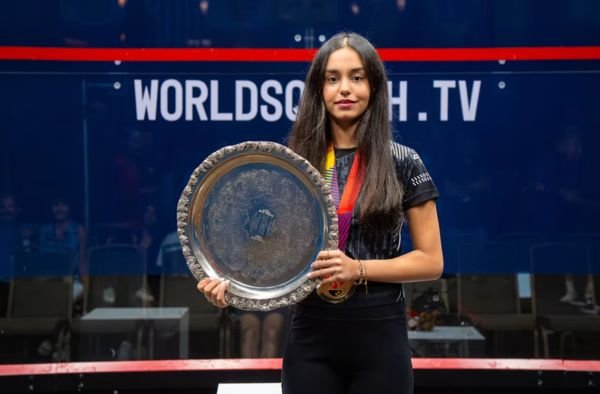
For over a decade, the World Junior Squash Championship had effectively belonged to Egypt. Their production line of champions, backed by a formidable domestic ecosystem, had made the title seem almost untouchable for the rest of the world. For Indian players, the tournament often represented a painful reminder of how close they could come without crossing the finish line.
Anahat Singh knew that feeling better than anyone. The Delhi teenager had entered the World Juniors four times before. Each campaign ended in heartbreak, with repeated exits in the quarterfinals before finally reaching the semifinals in 2025. The tournament became, in her own words, a “curse”. It was the one title that continued to elude one of the brightest talents Indian squash had ever produced.
Her fifth appearance would also be her last as a junior. There would be no sixth chance. Perhaps that urgency became her greatest strength. On the glass court in Ontario, Canada, Singh delivered the tournament of her life. After cruising past Lily Wilson of Australia, Chloe Pui Yin of Hong Kong and Malaysia’s Douce Ye San Lee, she confronted the biggest challenge in world squash, Egypt.
She defeated Habiba Rizk in the quarterfinals, Barb Sameh in the semifinals and Ruqayya Salem in the final, becoming the first Indian ever to win the World Junior Squash Championship. Her emphatic 11-3, 11-7, 11-9 victory over Salem also ended Egypt’s remarkable streak of 13 consecutive women’s titles, marking the first non-Egyptian champion since 2011.
The emotion that followed was entirely understandable. “I still feel like I’m dreaming,” Anahat told World Squash. “This tournament has been the worst tournament for me. I have been losing in the semis and quarters over the last four years. I have always said, if anyone asked, ‘This tournament’s a curse’, and I have never been able to play well in the event. This is my last year [as a junior] and my only chance to win it. It means the world.”
Those words carried the weight of years spent chasing an elusive dream. Anahat’s rise has never been built on overnight success. She first picked up a racket after trying badminton, a sport that helped develop the wristwork and deception that now define her squash. Her admiration for P. V. Sindhu inspired her early years, but it was squash that eventually became her identity.
By the age of 18, she had already broken into the world’s top 20 on the professional circuit, won PSA titles and established herself as India’s leading female squash player. She had balanced international tournaments with school examinations, once remarking, “I’m pushing through school work for exams in May.” Weeks later, she passed an even greater examination under the brightest lights in junior squash.
Much of her transformation has also come through the people around her. Former World No. 1 Gregory Gaultier, himself a player who famously lost four World Championship finals before winning the fifth, joined her coaching team with a perspective few others could offer. His experience of repeated heartbreak became invaluable for an athlete trying to overcome her own psychological barrier.
“I’m teaching her solutions instead of dwelling on frustrations,” Gaultier had said during the tournament. His advice remained simple yet profound: “You are doing what you love. So no complaints.”
India’s finest male squash player, Saurav Ghosal, has also mentored Singh, while coach Stephane Galifi has worked extensively on her tactical maturity. Together, they have encouraged an attacking style built around aggressive volleying, quick court movement and, equally importantly, the flexibility to adapt when Plan A stops working.
That adaptability became evident throughout the championship. The significance of Anahat’s victory extends beyond one teenager lifting a trophy. Former world No. 10 Dipika Pallikal understands perhaps better than anyone what Egyptian dominance has meant for international squash. “So when you play an Egyptian, you are not just playing an individual; you are playing someone who has come through one of the toughest systems in the sport.”
She added, “Every win against them is earned. That’s why whenever someone from outside Egypt wins a major title, it’s a significant moment for world squash. So for her to beat that streak of Egyptians winning this title and get one for India is fantastic.”
Pallikal believes the title represents something even bigger. “Titles are never just about a trophy. They represent years of discipline, sacrifice and the ability to deliver when the pressure is at its highest. Winning a title like this tells you that you are not just talented, you have learned how to handle expectations, adapt through a tournament and finish the job. That’s what separates champions from contenders. This is a huge testament to her ability to become one of the best squash players in the world. So I hope this is just the beginning.”
That hope is shared across Indian sport. With squash set to make its Olympic debut at the 2028 Los Angeles Games, Singh’s emergence could not have come at a better time. India has long produced outstanding players like Joshna Chinappa, Dipika Pallikal and Saurav Ghosal, but a world junior title had remained conspicuously absent.
Singh has finally filled that void, offering Indian squash not only a historic first but also genuine optimism for the future. Her achievement has drawn praise from across the country, with Prime Minister Narendra Modi stating that the victory would inspire more young Indians to take up the sport.
In many ways, Anahat Singh did not simply break a curse in Ontario. She broke a ceiling that had hovered over Indian squash for decades.
History will remember the trophy. Indian sport, however, may remember something even more valuable. On a summer evening in Canada, an 18-year-old from Delhi proved that the longest-standing barriers in sport often fall not because they become weaker, but because someone becomes fearless enough to challenge them.

