

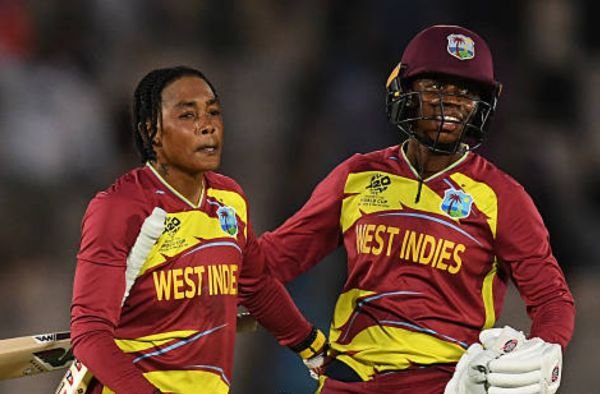
West Indies announced themselves as serious contenders at the ICC Women’s T20 World Cup 2026 with a stunning seven-wicket victory over defending champions New Zealand at the Hampshire Bowl. Chasing a challenging target of 163, the Caribbean side held their nerve in a tense finish as veteran batter Shemaine Campbelle produced the finest innings of her T20I career, guiding her team home with an unbeaten 90 from 62 deliveries.
The result marked one of the biggest upsets of the tournament so far and echoed West Indies’ famous victory over England at the previous Women’s T20 World Cup. Against a New Zealand side packed with experience and coming into the competition as reigning champions, West Indies showcased resilience, power, and composure under pressure to secure a statement win.
Campbelle’s remarkable innings featured seven boundaries and three sixes and was built on patience early before accelerating at crucial moments. Her knock became the backbone of a successful chase that was aided significantly by New Zealand’s disappointing fielding performance.
The White Ferns dropped several chances throughout the innings, allowing West Indies’ batters to capitalize and maintain control of the contest. The pursuit got off to a dramatic start when Qiana Joseph was run out in just the second over. A misunderstanding between the wickets with captain Hayley Matthews resulted in Joseph’s dismissal, and the frustration was evident as she made her way back to the pavilion.
Despite the early setback, Matthews responded positively. The West Indies skipper steadied the innings and gradually rebuilt momentum alongside Campbelle. The pair stitched together a crucial 74-run partnership for the second wicket that shifted the pressure back onto New Zealand. Matthews mixed caution with aggression during her 48-run knock from 37 balls.
She survived multiple chances as New Zealand’s fielders struggled to convert opportunities. A dropped catch by Izzy Sharp and further lapses in the field allowed West Indies to remain on track during the middle overs. Campbelle, meanwhile, grew stronger as the innings progressed. Initially content with rotating strike, she began finding boundaries with increasing regularity. Her ability to punish loose deliveries and clear the ropes at key moments ensured that the required rate never spiraled out of control.
For much of the evening, New Zealand appeared to be their own worst enemies. Several dropped catches, missed stumpings, and fielding errors allowed West Indies valuable lifelines.
A stumping chance against Campbelle went begging, while multiple catches offered by both Matthews and Campbelle failed to stick. Melie Kerr, Nensi Patel, and other fielders were unable to capitalize on opportunities that could have altered the outcome of the match.
The defending champions had moments where they seemed poised to regain control, particularly after Matthews departed for 48. However, every breakthrough was followed by another missed chance, allowing Campbelle to continue her match-winning effort. As the target narrowed, tension increased. Sophie Devine delivered a superb final over under immense pressure, conceding very little despite having only a handful of runs to defend. Yet Campbelle remained composed and scrambled through for the winning run with one ball remaining, sealing a famous victory for West Indies.
Earlier, New Zealand had produced a competitive batting performance after being asked to bat first. Wicketkeeper-batter Izzy Gaze provided the early momentum with an aggressive start at the top of the order. She raced to 39 from just 25 deliveries and struck boundaries all around the ground. Alongside Georgia Plimmer, she helped New Zealand reach 49 without loss inside six overs. The defending champions looked set for a massive total as Gaze dominated the powerplay. West Indies captain Hayley Matthews even missed a return catch that could have halted her progress much earlier.
At that stage, New Zealand appeared firmly in command. The momentum shifted dramatically once Aaliyah Alleyne entered the attack. The medium pacer produced one of the standout bowling spells of the tournament, claiming four wickets for 27 runs. She first removed Plimmer before dismissing captain Melie Kerr and Gaze in quick succession. Her disciplined lengths and ability to cramp batters for room disrupted New Zealand’s rhythm and transformed the contest.
Within a span of two overs, New Zealand slipped from a position of strength to 56 for 3. The absence of veteran opener Suzie Bates, who missed a Women’s T20 World Cup match for the first time in tournament history, also placed greater responsibility on the middle order.
Facing a collapse, Brooke Halliday and Sophie Devine launched a recovery effort. Their partnership injected much-needed momentum and helped New Zealand rebuild after losing wickets in clusters. Devine contributed 22 from 15 balls before falling to a sharp catch in the deep, while Halliday anchored the innings with a valuable 40 from 32 deliveries.
In the closing overs, Maddy Green provided the finishing touches with an unbeaten 35 from 22 balls. Her late acceleration, which included a towering six and several boundaries, lifted New Zealand to 162 for 6 and gave the bowlers a target to defend.
Campbelle’s career-defining innings, combined with Matthews’ leadership and Alleyne’s crucial spell, delivered one of West Indies’ most memorable World Cup victories. For New Zealand, the defeat exposed costly fielding frailties and served as an early setback in their title defense. For the West Indies, it was a reminder that on the biggest stage, they remain capable of challenging and defeating the very best teams in women’s cricket.

