

Aryna Sabalenka arrived at the China Open carrying the weight of a former world No. 1 and one of the most feared hard-court games in women’s tennis. She left Beijing carrying another early-season disappointment.
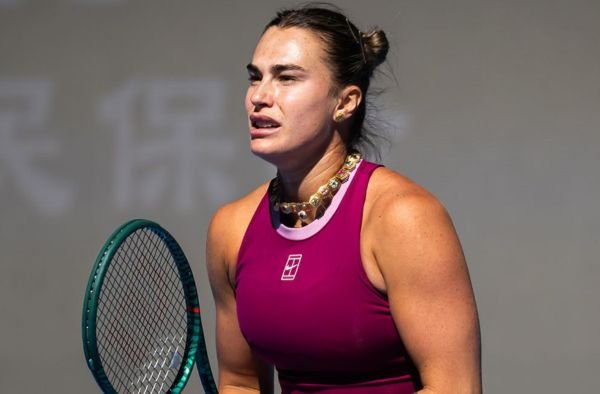
The second-seeded Belarusian was knocked out of the China Open 2026 in the third round on Sunday, beaten 6-4, 6-3 by 20-year-old Czech player Nikola Bartunkova in one hour and 35 minutes. It was not merely an upset on the scoreboard. It was a performance built on composure, deep returning and relentless defence from Bartunkova, who absorbed Sabalenka’s power and refused to allow the four-time Grand Slam champion to dictate the match.
The defeat means the China Open has now lost both its top two women’s seeds before the fourth round. World No. 1 Elena Rybakina had already suffered a shock second-round defeat to Alina Charaeva on Saturday. For Bartunkova, however, the afternoon was about something much bigger than the collapse of the draw.
It was the biggest victory of her young career. “I focused on myself, to be calm,” Bartunkova said. “She’s a legend… so I’m really happy that I won the match,” she said of the four-time Grand Slam champion. Sabalenka’s missed opportunities prove costly. Sabalenka’s problems began almost immediately. Bartunkova broke in the opening game and established an early advantage that forced the Belarusian to chase the set rather than control it. Sabalenka eventually created five break-point opportunities in the sixth game, but none were converted.
That game proved to be a critical turning point. Instead of allowing the second seed back into the contest, Bartunkova stayed composed, defended aggressively and continued to send the ball deep. Her ability to extend rallies prevented Sabalenka from finding the short balls she normally uses to unleash her devastating forehand. The Czech eventually closed out the opening set 6-4. For Sabalenka, the second set offered an opportunity to reset. Instead, the frustration intensified. From frustration to final-point defeat. Sabalenka managed to stay within touching distance early in the second set, but Bartunkova continued to make her work for every point.
The conditions added another layer of difficulty. With the match moving between shade and sunlight, Sabalenka put on a cap during the eighth game of the opening set, but the adjustment did little to change the momentum. At 2-1 in the second set, Sabalenka’s frustration boiled over. After being broken, the Belarusian threw her racquet, a visible sign that the match was slipping away. Bartunkova did not blink. She held her nerve, protected her advantage and moved to match point at 5-3. Sabalenka’s final attempt to stay alive ended with a return into the net.
The Czech had completed one of the biggest wins of her career, 6-4, 6-3. The official WTA report confirmed Bartunkova’s victory and identified her as the No. 26 seed in the 96-player WTA 1000 draw. A tournament suddenly without its top two seeds. The significance of Sabalenka’s defeat becomes even greater when viewed alongside Rybakina’s early departure.
Rybakina, who recently replaced Sabalenka at the top of the WTA rankings following her US Open triumph, was beaten 3-6, 6-4, 6-3 by unseeded Alina Charaeva in the second round. It was Rybakina’s first match as world No. 1 and her defeat created the first major opening in the Beijing draw. Sabalenka’s exit a day later completed the top-of-the-draw shock. The two players who entered the tournament as the first and second seeds are now both gone.
The China Open is a WTA 1000 tournament, meaning the stakes are considerably higher than those of a regular tour event. The Beijing tournament features a 96-player singles draw and offers 1,000 ranking points to the champion. That makes Bartunkova’s run even more significant. The Belarusian started 2026 with major success, winning the Sunshine Double at Indian Wells and Miami, but she has struggled to maintain that level during the latter stages of the season. She reached the US Open final but lost to Rybakina, ending her bid for another Grand Slam title. That result also contributed to Rybakina taking over the No. 1 ranking.
Sabalenka’s Beijing campaign therefore represented an opportunity to respond. Instead, it ended in the third round. Reuters reported that Sabalenka has not won a title since her Indian Wells and Miami triumphs earlier this season. Beating Sabalenka creates the headline, but progressing through the next round will determine whether this becomes a breakthrough tournament or simply a spectacular upset. She will face Austria’s Sinja Kraus in the round of 16.
For the 20-year-old Czech, the opportunity is enormous. She has already demonstrated that the occasion does not overwhelm her. Against Sabalenka, Bartunkova repeatedly chose patience over panic, absorbed the Belarusian’s pace and waited for opportunities. The next opponent will know exactly what she is capable of. That brings a different kind of pressure. The underdog is no longer invisible.
The most interesting part of Sabalenka’s China Open exit is not that another top seed has lost. Women’s tennis has increasingly become a landscape where the gap between established champions and the next generation is narrowing. Bartunkova’s victory is another example of a young player showing that ranking and reputation do not necessarily dictate the rhythm of a match. Sabalenka’s game is built around power. When she gets time on the ball, few players can match her ability to dictate rallies.
Bartunkova’s answer was simple but effective: defend deep, stay composed and deny Sabalenka the rhythm she needed. That tactical discipline turned five missed break-point opportunities into a psychological advantage. For Sabalenka, the defeat raises questions about her form heading into the final stretch of the season. For Bartunkova, it may be the beginning of something much bigger. With Rybakina and Sabalenka both out, the China Open has lost its top two seeds. But women’s tennis has gained another contender worth watching. And in Beijing, a 20-year-old Czech has just announced herself on one of the biggest stages of the season.

