

Indian shooting has rarely struggled to produce talent. From Abhinav Bindra’s historic Olympic triumph to Gagan Narang’s consistency, from Manu Bhaker’s fearless emergence to the country’s recent dominance across World Cups, India has built one of the strongest shooting programmes in the world. Yet sustaining excellence is often more difficult than discovering it. Every Olympic cycle demands new champions capable of carrying the sport forward while living up to the expectations created by their predecessors.
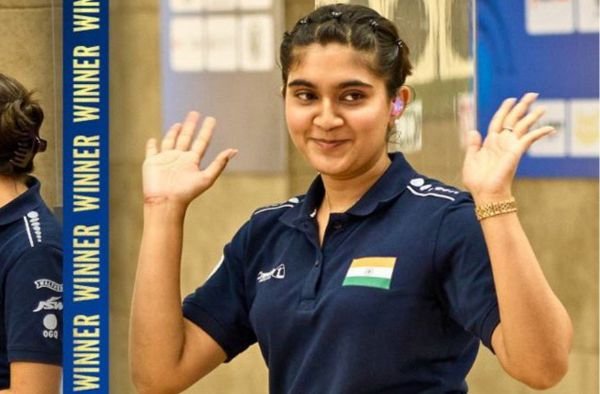
Esha Singh appears increasingly ready to shoulder that responsibility. The 21-year-old continued her remarkable rise by winning the women’s 25m pistol gold medal at the ISSF World Cup in Hangzhou, China, defeating home favourite Zhang Yueyue 40-37 in the final. The victory marked her second consecutive ISSF World Cup gold in the event after winning the same discipline in Munich earlier this season. It also became her third individual medal of 2026, following a silver in the 10m air pistol and a gold in the 25m pistol at the Munich World Cup, confirming that her success is no longer a flash of brilliance but a pattern of sustained excellence.
India’s celebrations did not end there. Two-time Olympic medallist Manu Bhaker produced another composed performance to claim bronze after winning a crucial shoot-off, ensuring India secured a double podium finish in one of the most competitive pistol events on the international calendar. The medals lifted India’s tally in Hangzhou to three, following Sainyam Vij’s silver in the women’s 10m air pistol earlier in the competition.
While the medals added another chapter to India’s growing success in shooting, the larger story belonged to Esha Singh. For years, Indian shooting has revolved around established names such as Manu Bhaker, Saurabh Chaudhary and Elavenil Valarivan. Esha, despite impressive junior credentials, often developed away from the spotlight. That anonymity is beginning to disappear.
Born in Hyderabad, Esha was introduced to shooting at the age of eight after accompanying her father to a shooting range. What started as curiosity soon evolved into one of the country’s most promising careers. Her rapid progress through the junior circuit culminated in multiple international medals before she made the seamless transition into senior competition. She represented India at the 2022 Asian Games and the Paris 2024 Olympics, experiences that accelerated her development despite the intense competition at the highest level.
Unlike many specialists who focus exclusively on one event, she has consistently excelled in both the 10m air pistol and the 25m pistol disciplines. Winning medals across both events requires adapting to different formats, rhythms and technical demands. The precision required in the 10m event contrasts sharply with the speed and pressure of the rapid-fire stages in the 25m pistol. Few athletes manage to master both.
Her performances this season suggest she has done exactly that. Although she entered the Hangzhou final as the eighth qualifier with a score of 585-18x, qualification rankings became irrelevant once the final began. Calm under pressure, Esha steadily built momentum while several experienced competitors faltered. Her tally of 40 hits in the final demonstrated not only technical precision but also the mental composure that separates champions from finalists. That composure has become one of the defining features of India’s new generation of shooters.
Unlike previous eras when Indian athletes occasionally struggled to translate qualification performances into medals, the current crop has repeatedly delivered in high-pressure finals. Whether it has been Manu Bhaker’s Olympic success, Rudrankksh Patil’s World Championship title or Esha Singh’s recent World Cup victories, Indian shooters increasingly look comfortable performing when every shot carries immense significance.
The competition in Hangzhou reinforced that evolution. Manu Bhaker, who qualified sixth with a score of 586-20x, once again showcased her experience by fighting through a tense shoot-off to secure bronze. Meanwhile, Olympian Rahi Sarnobat, Simranpreet Kaur Brar and Abhidnya Ashok Patil narrowly missed out on the final, highlighting the remarkable depth within Indian women’s pistol shooting. In men’s trap, Bhowneesh Mendiratta reached the final after surviving a qualification shoot-off before eventually finishing sixth.
Esha’s latest triumph also carries significance beyond the medal table. Individual World Cup winners automatically qualify for the prestigious ISSF World Cup Final, scheduled to be held in Rome later this year. More importantly, victories at this stage of the Olympic cycle help establish confidence, international reputation and consistency ahead of the 2028 Los Angeles Olympic Games, where India will once again harbour genuine medal ambitions.
For Indian shooting, perhaps the most encouraging aspect is the emergence of healthy internal competition. No longer does the country rely on one or two elite athletes to deliver medals. Instead, almost every international event now features multiple Indians capable of reaching finals and challenging for podium finishes. That depth has been built through years of investment in grassroots programmes, the Target Olympic Podium Scheme, improved coaching structures and regular international exposure. The result is a pipeline that continues producing world-class shooters capable of competing with the traditional powerhouses of China and the Republic of Korea.
Esha Singh is rapidly becoming one of the brightest symbols of that system. Back-to-back World Cup gold medals rarely happen by accident. They are the product of consistency, preparation and an ability to handle pressure repeatedly against the world’s best. At just 21, she has already demonstrated all three. There is still a long road to Los Angeles, and Indian shooting has learned that World Cup success does not automatically guarantee Olympic medals. Yet champions are built through performances like these, where confidence is earned one final at a time.
For now, Esha Singh’s latest gold is more than another addition to India’s medal tally. It is another reminder that the future of Indian shooting is already here, and it is hitting the target with remarkable precision.

