

On Saturday, Arundhati Choudhary became a Commonwealth Games Champion, and the gold was as hard-fought as it comes. She defeated Chantelle Reid in the women’s 70kg after eliminating defending champion Rosie Eccles a day earlier in the semifinals.
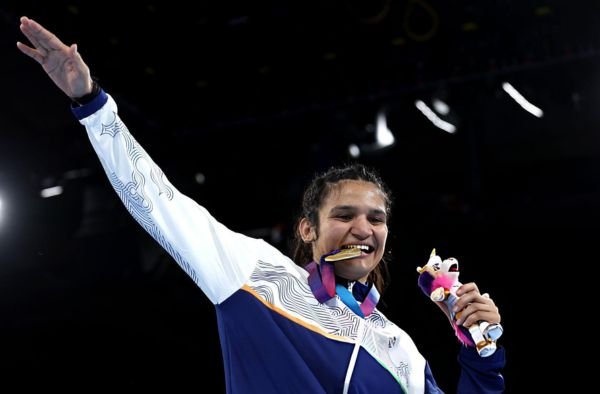
Compared to the other champions, Choudhary’s triumph stood apart. The other six champions come from Haryana, which is considered to be the heartland of Indian boxing.
Arundhati hails from Kota, Rajasthan — which is better known for IIT enthusiasts rather than professional boxers. She had to build her boxing journey from the ground up when she first decided to pursue it, as there wasn’t even a boxing coach in her city. However, before that, she had to convince her father.
Arundhati’s father, Suresh Choudhary, still remembers the conversation he had with his daughter.
“You know how big the education industry is in Kota. It’s a way of life. Arundhati was really intelligent as well. She was especially brilliant in mathematics. I told her I wanted her to sit for the IIT exam or study to become an IAS. I was certain she’d clear at least one of them and tried to convince her how special it would be,” he tells Sportstar.
She had an answer, and Suresh was taken aback by it.
“She asked me how many students clear the IAS and how many clear the IIT entrance exams. I told her about 200 clear the IAS and around 10,000 clear the IIT exam. She then asked me, ‘Papa, how many Indians have won an Olympic gold medal?’ At that time, I only knew of Abhinav Bindra. When I told her that, she said she wanted to become the first Indian woman to do the same,” he recalls.
“I’m a businessman. No one from my family or my wife’s family has ever played sports at any level. I genuinely wondered where she was getting that confidence from.”
Eventually, he gave in. “Arundhati always got what she wanted from me,” he laughs.
Even today, the destination for Arundhati hasn’t changed. “The Olympics are like the roof of a house. But you can’t just jump onto the roof. To get there, you have to climb the stairs. The Commonwealth Games, Asian Games and World Championships are those stairs. If you climb them one by one, reaching the roof becomes easier,” she had told this publication before leaving for Glasgow.
For her, the Commonwealth gold isn’t the finish line. It is just a stepping stone for Los Angeles 2028 and the Olympic medal she has dreamed of for so long.
When Arundhati looks back now, she has always had the temperament to fight.
“I was the naughtiest child in the family,” Arundhati says with a laugh. “I used to get into fights almost every day in school. Sometimes I’d beat up boys, and they would go home crying. Their parents would complain that my parents weren’t raising a girl properly.”
Her father remembers one such incident: “One day I got an angry call from a local politician who said, ‘Your daughter beat my son up so badly that he was bleeding.’ Later I found out she’d hit him with a bottle because he wasn’t letting the girls fill water from the school tap,” he recalls.
However, despite the regular complaints, she never found herself in serious trouble.
“I was always my father’s favourite, so he’d calm things down. He’d tell me to stop getting into trouble, but a few days later I’d end up fighting again,” she said.
Her father’s indulgence also meant she was allowed to play sports.
“It was a very big thing,” Suresh says. “We come from a very traditional family. It was almost unthinkable for girls to even wear shorts. But Arundhati loved sports, and I didn’t mind channelling her energy somewhere,” he says.
Before she found boxing, Arundhati was naturally good at basketball. However, her father had different ideas for her, and that’s when she decided to become a boxer.
“He told me I could play sports, but it had to be an individual event. He’d watched my matches and saw that I was scoring almost every point for the team. He felt I shouldn’t be carrying everyone else,” Arundhati recalls.
“I thought her interest in sport would last only a few months. When she said she wanted to become a boxer, I was worried. She always came first or second in class. Her elder sister had cleared her medical entrance exams, and I always felt Arundhati would clear her medical or engineering entrance exams as well. I felt she was going to waste her talent,” he says.
Mr Choudhary’s objections couldn’t last long in front of his daughter. “I did a lot of emotional drama for two or three days,” Arundhati says with a grin. “I stopped eating. Actually, I ate just enough to show him that I was upset.”
Finding a Coach:
Convincing her father was step one. Step two was to find a coach.
“There wasn’t a good boxing academy or coach, not just in Kota but anywhere in Rajasthan,” Suresh recalls. “There was a state academy in Bhopal, but they weren’t admitting out-of-state players. I even considered sending her to a hostel in Haryana, but I wasn’t sure how safe they were.”
A friend had suggested they meet a local Wushu coach named Ashok Gautam. But there was one problem.
“He told me very honestly that he had never formally trained or coached boxing,” says Suresh. “At that point I thought, how different could the two sports really be? So I asked him to learn from YouTube and teach Arundhati.”
From there on, Gautam watched YouTube videos every day and would pass on what he had learnt to Arundhati. The arrangement may have been unconventional, but the results weren’t.
“It was difficult in the beginning, but I enjoyed it because I was learning something new every day,” Arundhati recalls.
Within months, she was dominating state competitions. Less than a year after taking up the sport, she had qualified for the sub-junior nationals. What had begun as an experiment between a determined teenager and a coach teaching himself through YouTube suddenly looked like something much more serious.
By the end of her very first national championship, she had won a gold and been named the tournament’s Best Boxer.
In 2018, during a match, Arundhati’s career nearly came to an end when she suffered repeated blows to her head while she didn’t have protective headgear on and developed a blood clot.
Her father initially wanted her to quit; however, he eventually agreed to let her compete on one condition.
“I spent nearly two weeks in hospital. The doctors told my family boxing could be too dangerous because I had started experiencing memory loss. I cried a lot because I thought boxing was over,” she recalls.
“He told me, ‘If you’re going to continue boxing, then your goal has to be the very top. Don’t do it just because it might get you a government job or because you’ve represented India. If you started boxing because you wanted to win an Olympic gold medal, then that has to remain your goal,” Arundhati recalls.
Over the next few years, Arundhati established herself as one of the country’s promising talents. In 2021, she won a gold at the Youth World Championships. Two years later, she went on to represent India at the Asian Games, though she lost to eventual champion and future Olympic silver medallist Yang Liu of China.
The next stop for Arundhati was meant to be Paris 2024. But life barely goes on as one wishes, and sometimes it is too cruel. Just before a crucial Olympic qualification game, Arundhati had learned that her mother had been admitted to the intensive care unit after suffering a sudden illness.
“I was extremely attached to my mother. When I entered the ring, I could only think about her. I couldn’t focus on the bout. I lost, and with it my Olympic dream,” she said.
The defeat was tough, and she stepped away from boxing for two months, thinking that her chance to compete at the Olympics had been taken away forever. Eventually, realisation struck that she could not stay away, and instead of abandoning the dream, she simply pushed it back.
“I told myself that if not in 2024, then in 2028. I have to win an Olympic medal, no matter what,” she says.
Over the course of the past few months, Arundhati has been moving steadily towards her dream. She won gold at the Boxing World Cup Finals in New Delhi before adding another title at the Asian Championships in Ulaanbaatar earlier this year.
The Commonwealth Games were a test, and Arundhati cleared it. However, it is just another step. For her, the roof still lies ahead.
(Inputs sourced from Sportstar)

